Usama

I am a Full Stack Developer specializing in the MERN Stack (MongoDB, Express.js, React.js, Node.js) with hands-on experience building scalable, high-performance web applications. I focus on writing clean, maintainable code and building real-world products that solve meaningful problems. Recently, I developed a production-ready MERN Stack E-Commerce platform featuring secure authentication, product management, shopping cart functionality, and payment integration. Through this project, I implemented RESTful APIs, optimized database queries, and built responsive UI components to deliver a smooth user experience. Technical Skills Frontend: React.js, JavaScript (ES6+), HTML5, CSS3, Tailwind CSS Backend: Node.js, Express.js, REST APIs Database: MongoDB, PostgreSQL Tools: Git, GitHub, Vercel, JWT Authentication, Stripe API Practices: Clean Code, Component-Based Architecture, Agile Development What I Bring ✔ Strong problem-solving mindset ✔ Ability to design scalable full-stack applications ✔ Focus on performance optimization and clean architecture ✔ Continuous learning and growth mindset I am passionate about building modern web applications, improving user experience, and contributing to impactful software products.

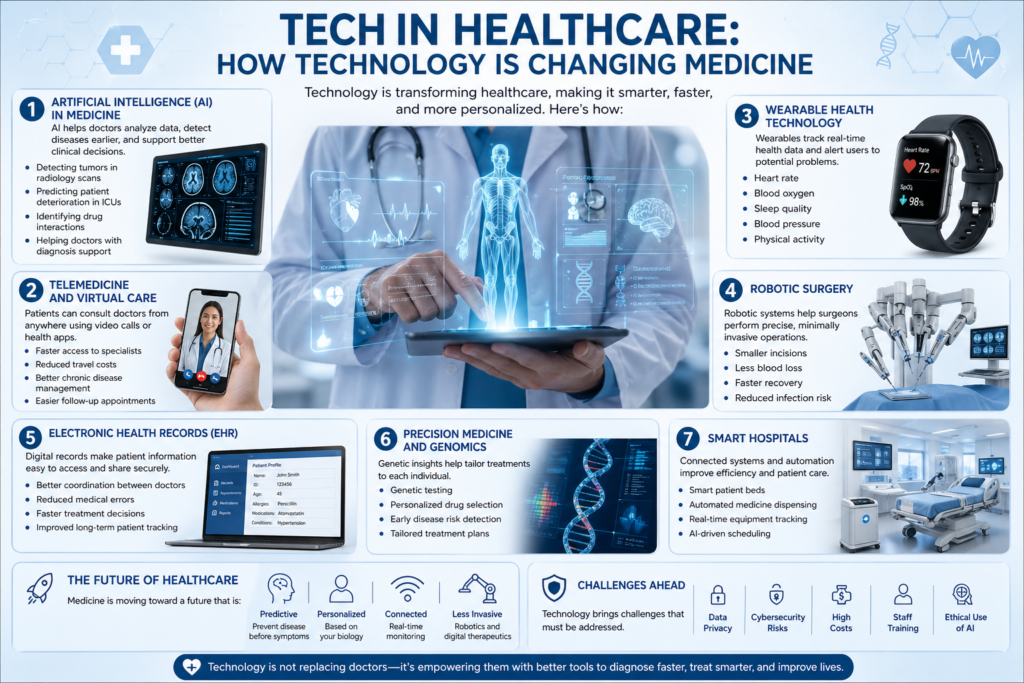
Tech in Healthcare How Technology Is Changing Medicine

Tech in Healthcare: How Technology Is Changing Medicine

Transforming Medicine, Saving Lives & Reshaping Patient Care in 2026 Introduction Imagine a world where a doctor can diagnose cancer before a single symptom appears, where yoursmartwatch detects a heart attack before you feel chest pain, and where a patient in a remote villagereceives world-class medical advice via a smartphone app. That world is not science fiction — it ishappening right now, thanks to tech in healthcare.The intersection of technology and medicine has become one of the most exciting and consequentialdevelopments of our time. From artificial intelligence and telemedicine to robotic surgery and genomics,tech in healthcare is fundamentally changing how we prevent, diagnose, and treat disease 1. What Is Tech in Healthcare? Tech in healthcare refers to the application of modern digital tools, devices, software, and systems to improve the delivery, quality, and efficiency of medical services. It is a broad field that encompasses everything from simple mobile health apps to complex AI diagnostic systems and genome sequencing platforms. Healthcare technology is not new. The invention of the X-ray in 1895, the development of the EKG machine, and the introduction of MRI scanners all represent earlier waves of medical innovation. What makes today’s era different is the speed, scale, and intelligence of technological change.

Tech in Healthcare: How Technology Is Changing Medicine Read More »

prompt engineering

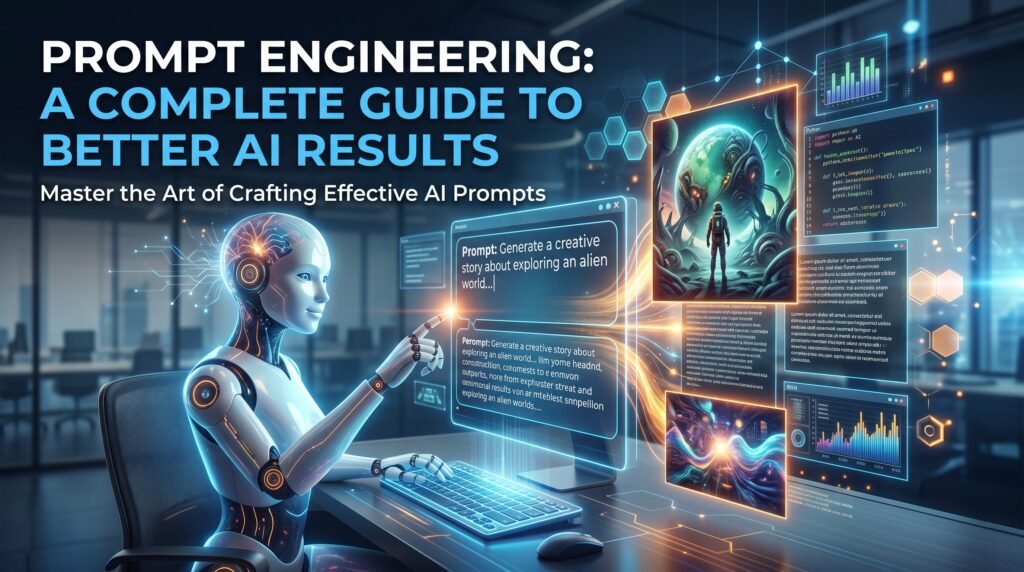
Prompt Engineering: A Complete Guide to Better AI Results

Introduction Have you ever typed a question into ChatGPT and gotten a confusing or useless answer? The problem usually isn’t the AI. It’s the prompt. Prompt engineering is the skill of writing clear instructions so an AI model understands exactly what you want. It sits at the crossroads of language, logic, and technology. And in 2026, it’s quickly becoming one of the most valuable skills anyone can learn, whether you’re a student, marketer, developer, or business owner. In this guide, you’ll learn what prompt engineering really means, why it matters, and how to do it well. We’ll cover real examples, expert tips, common mistakes, and answers to the questions people search for most. By the end, you’ll be able to write prompts that get sharper, faster, and more useful results from any AI tool Table of Contents What Is Prompt Engineering?​ Prompt engineering is the process of designing and refining the text input, or “prompt,” that you give to an AI model to produce the best possible output. Think of it as learning how to ask better questions so you get better answers. An AI model like ChatGPT, Claude, or Gemini doesn’t read your mind. It reads your words. The way you phrase a request directly shapes the quality, tone, and accuracy of the response you get back. At its core, prompt engineering involves: Choosing the right words and structure Giving the model context and constraints Specifying the format you want Testing and refining until the output matches your goal Why It’s Called “Engineering” The word “engineering” might sound intimidating, but it fits. Just like a civil engineer designs a bridge with precision, a prompt engineer designs instructions with precision. Small changes in wording can lead to very different results, so the process involves testing, measuring, and improving, exactly like engineering. Why Prompt Engineering Matters in 2026 AI adoption has grown massively. According to a 2025 McKinsey survey on workplace AI use, a majority of organizations reported using generative AI in at least one business function, up sharply from prior years. As more people rely on AI daily, the ability to communicate with these systems efficiently has become a real advantage. Here’s why prompt engineering matters right now: Better output, less rework. A well-written prompt saves time by reducing back-and-forth corrections. Higher accuracy. Clear prompts reduce hallucinations and vague answers. Competitive edge. People who master prompt engineering finish tasks faster than those who don’t. New career paths. Roles like “AI prompt specialist” and “conversation designer” are appearing across industries. Better AI-human collaboration. As AI becomes part of everyday workflows, knowing how to guide it well is becoming as essential as knowing how to search the web effectively. Simply put, prompt engineering turns a general-purpose AI tool into a personalized assistant that actually understands your needs. How Prompt Engineering Works To understand how prompt engineering works, it helps to know a little about how AI language models process text.Large language models (LLMs) predict the next word in a sequence based on patterns learned from huge amounts of text. They don’t “think” the way humans do. Instead, they respond based on probability and pattern recognition. This means your prompt acts like a steering wheel. The clearer your direction, the more accurately the model can follow it. The Basic Anatomy of a Prompt A strong prompt usually includes some combination of: Instruction – What you want the AI to do Context – Background information the AI needs Input data – Any specific details, text, or examples Output format – How you want the response structured Constraints – Length, tone, or style requirements For example, compare these two prompts: Weak prompt: “Write about marketing.” Strong prompt: “Write a 200-word blog introduction about email marketing for small business owners. Use a friendly tone and include one statistic.” The second prompt gives the model everything it needs to succeed Core Prompt Engineering Techniques There isn’t just one way to write a good prompt. Over the past few years, several techniques have emerged that consistently improve results. Zero-Shot Prompting This means asking the AI to complete a task without giving any examples. It works well for simple, well-known tasks like summarizing text or answering general questions. 2. Few-Shot Prompting Here, you give the AI a few examples of the input and desired output before asking it to complete a new one. This helps the model understand the pattern you want. Example: Turn these into product taglines: Shoes -> “Step into comfort.” Coffee -> “Wake up to flavor.” Backpack -> ? Chain-of-Thought Prompting This technique asks the AI to reason step-by-step before giving a final answer. It’s especially useful for math problems, logic puzzles, or complex decision-making tasks. Example: “Solve this step by step, then give the final answer.   4. Role Prompting You assign the AI a specific role or persona, such as “Act as a financial advisor” or “Act as a professional copywriter.” This shapes the tone, vocabulary, and depth of the response. 5. Iterative Prompting Instead of expecting perfection on the first try, you refine your prompt based on the AI’s response. This back-and-forth process often produces the best results. Prompt Engineering Examples You Can Use Today Here are practical, ready-to-use examples across different needs: For content writing: “Write a 300-word blog post about healthy morning routines, using short sentences and an encouraging tone.” For coding help: “Review this Python function for bugs and suggest improvements. Explain your reasoning in simple terms.” For business use: “Create a list of 10 subject lines for a Black Friday email campaign targeting online shoppers.” For learning: “Explain quantum computing to a 12-year-old using a simple analogy.” For data analysis: “Summarize the key trends in this dataset in three bullet points, then suggest one action based on the data.” Notice how each example includes a clear task, context, and format. That structure is the foundation of effective prompt engineering. Expert Tips for Better Prompts Here are some practical tips that experienced prompt engineers rely on: Be specific, not

Prompt Engineering: A Complete Guide to Better AI Results Read More »

5G Networks and the Edge: Driving Innovation in IoT

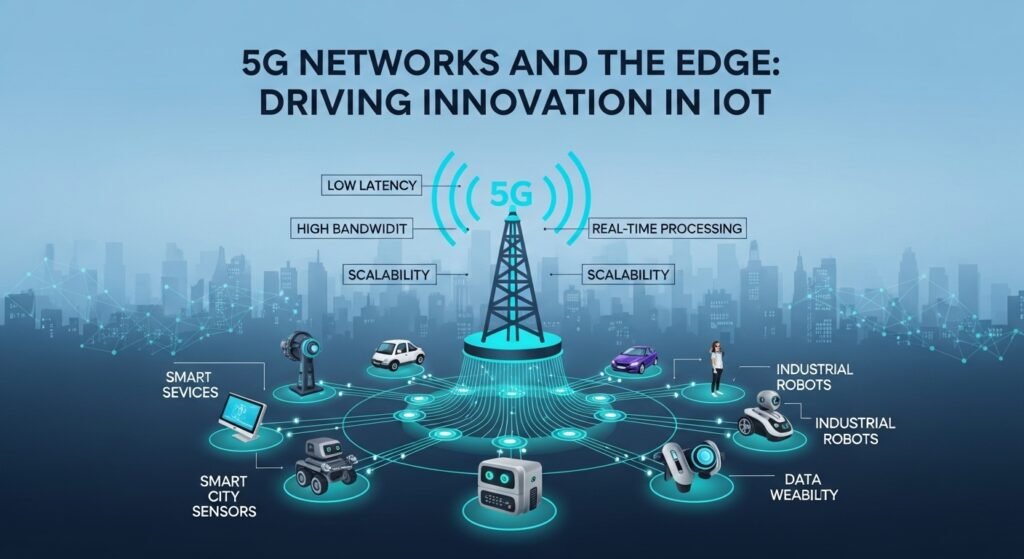
5G Networks and the Edge: Driving Innovation in IoT

 Explore how 5G Networks and the Edge are driving innovation in IoT withreal-world use cases, benefits, and future trends. Imagine a surgeon in London guiding a robotic arm in Mumbai — in real time, with zero noticeable delay. Or a self-driving car processing thousands of sensor signals every second without missing a beat. These scenarios are no longer science fiction. They are becoming reality because of one powerful combination: 5G Networks and the Edge: Driving Innovation in IoT. We are living through a connectivity revolution. The Internet of Things (IoT) has alreadyconnected billions of devices — from industrial sensors to smart home gadgets. But legacy networks were never designed for this scale or speed. Enter 5G and edge computing: a duo that is reshaping how devices communicate, how data is processed, and how businesses create value. This article dives deep into how 5G and edge computing work together, why this combination matters for IoT, and what it means for industries, developers, and everyday users around the world. Table of Contents 1. What Are 5G Networks? A Quick Overview 2. Understanding Edge Computing and Its Role in IoT 3. How 5G and Edge Computing Work Together 4. Key Benefits of 5G + Edge for IoT Innovation 5. Real-World Applications Across Industries 1. What Are 5G Networks? A Quick Overview 5G is the fifth generation of wireless technology. It is not simply a faster version of 4G — it is a completely new architecture designed from the ground up to handle a world saturated with connected devices. The three pillars of 5G: • Enhanced Mobile Broadband (eMBB) — speeds up to 20 Gbps for data-heavy applications like 4K/8K streaming and AR/VR. • Ultra-Reliable Low-Latency Communication (URLLC) — latency as low as 1 millisecond, critical for autonomous vehicles and remote surgery. • Massive Machine-Type Communications (mMTC) — supports up to 1 million devices per square kilometre, perfect for dense IoT deployments. According to the GSMA, there will be over 1.7 billion 5G connections globally by the end of 2025, representing nearly 20% of all mobile connections. This explosive growth is creating the backbone that IoT needs to truly scale. 2. Understanding Edge Computing and Its Role in IoT Traditional cloud computing processes data in centralised data centres — often thousands of kilometres from where that data is generated. For many IoT use cases, this distance introduces unacceptable delays. Edge computing solves this by moving processing power closer to the data source — to the ‘edge’ of the network. This could be a local server in a factory, a base station on a street corner,or a mini data centre inside a retail store. Why edge computing matters for IoT: • Reduces round-trip data travel, cutting latency from hundreds of milliseconds to under 5ms. • Reduces bandwidth costs by processing and filtering data locally before sending to the cloud. • Improves data privacy — sensitive data never leaves the local environment. • Enables offline functionality — devices keep working even if the cloud connection drops. • Supports AI inference at the device level for real-time decision-making. A 2024 IDC report found that more than 50% of new enterprise IT infrastructure will be deployed at the edge by 2026 — a staggering shift driven largely by the growth of IoT applications. Key Benefits of 5G + Edge for IoT Innovation Real-World Applications Across Industries ■ Healthcare • Remote patient monitoring via 5G-connected wearables sends vitals to doctors in real time. • Robotic-assisted surgery uses 5G’s ultra-low latency to eliminate dangerous lags. • Edge AI analyses medical imaging on-site, speeding up diagnosis significantly. • Example: Ericsson and King’s College London demonstrated remote robotic surgery over a live 5G network. ■ Manufacturing & Industry 4.0 • Connected machines on the factory floor communicate via 5G to coordinate tasks. • Predictive maintenance sensors detect equipment anomalies before failures occur. • AR-assisted maintenance guides workers using real-time edge-processed visual overlays. • Example: Volkswagen deployed 5G-connected IoT in its smart factory in Wolfsburg, Germany. ■ Autonomous Vehicles • Self-driving cars process sensor data at the edge in under 10ms to make split-second decisions. • Vehicle-to-everything (V2X) communication uses 5G to share road conditions instantly. • Traffic management systems process data from thousands of vehicles simultaneously. ■■ Smart Cities • 5G-connected streetlights, waste management, and water systems create responsive urban infrastructure. • Real-time traffic management reduces congestion by dynamically adjusting signals. • Edge computing processes surveillance data locally, reducing privacy risks. • Example: Singapore’s Smart Nation initiative uses 5G IoT for city-wide monitoring and efficiency. ■Agriculture • Precision agriculture sensors monitor soil moisture, crop health, and weather in real time.• Drones equipped with 5G transmit crop analysis data directly to edge servers on farms. • Automated irrigation systems respond instantly to sensor data without cloud delays. 10. Internal & External Link Strategy 5 Internal Link Ideas: ■ What Is Edge Computing? A Beginner’s Guide → /edge-computing-guide ■ IoT Security Best Practices for 2025 → /iot-security-best-practices ■ How 5G Is Transforming Smart Manufacturing → /5g-smart-manufacturing 3 External Authority Sources: ■ GSMA Intelligence — 5G Connections Forecast: https://www.gsma.com/intelligence ■ ETSI MEC Standards — Multi-Access Edge Computing: https://www.etsi.org/technologies/multi-access-edge-computing ■ McKinsey Global Institute — IoT Value Report: https://www.mckinsey.com/industries/internet-of-thing ■ References & Authority Sources [•] GSMA Intelligence. (2024). The Mobile Economy 2024. https://www.gsma.com/intelligence [•] IDC. (2024). Worldwide Edge Spending Guide. https://www.idc.com [•] Statista. (2024). Number of IoT Connected Devices Worldwide 2019–2030. https://www.statista.com [•] ETSI. (2024). Multi-Access Edge Computing Standards. https://www.etsi.org/mec [•] McKinsey Global Institute. (2023). The Internet of Things: Catching Up to an Accelerating Opportunity. [•] Ericsson. (2024). Ericsson Mobility Report June 2024. https://www.ericsson.com/mobility-report

5G Networks and the Edge: Driving Innovation in IoT Read More »

Virtual Reality Experiences The Ultimate 2025 Guide 1 https://nexusblogs.com/

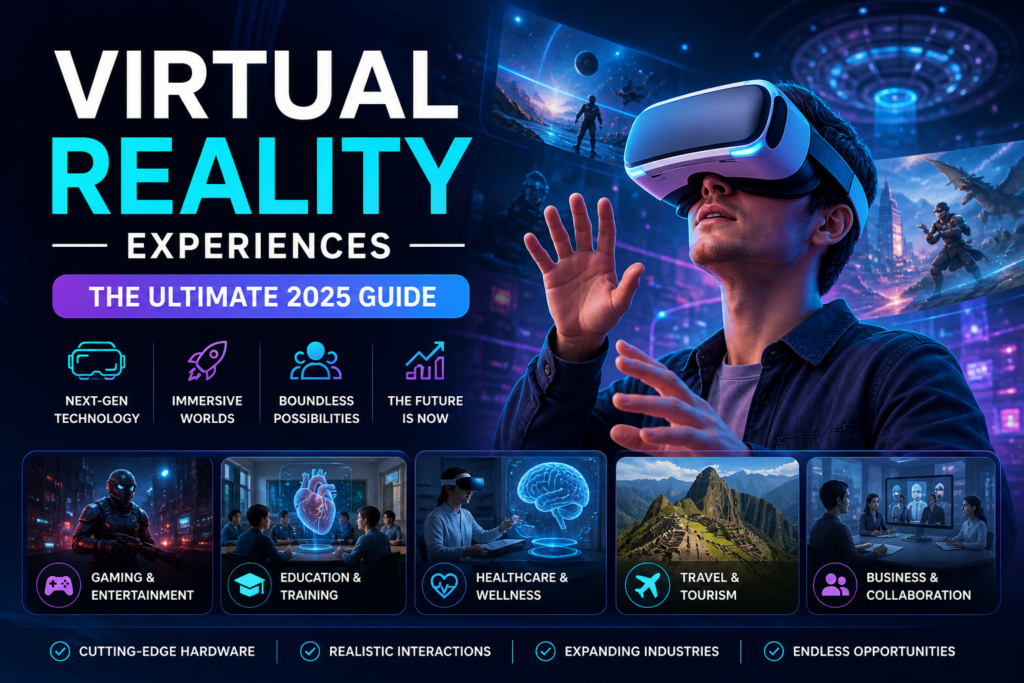
Virtual Reality Experiences: The Ultimate 2025 Guide

Table of Contents 1. What Are Virtual Reality Experiences? 2. The Global VR Market: Key Statistics & Growth 3. Types of Virtual Reality Experiences 4. Top Industries Using VR Technology 5. Best VR Headsets for Every Budget 6. Virtual Reality Gaming: A Revolution in Play 7. VR in Education: Learning Like Never Before 8. VR in Healthcare: Healing Through Immersion 9. Metaverse Experiences & Social VR 10. Expert Tips for the Best VR Experiences 11. Common Mistakes to Avoid in VR 12. FAQs — People Also Ask 13. Conclusion & Call to Action 14. Media Suggestions, Internal & External Links Introduction Imagine standing on the summit of Mount Everest without leaving your living room, or performing a complex surgery simulation before ever touching a real patient. That is the transformative power of virtual reality experiences — and in 2025, this technology is no longer science fiction. It is a fast-growing reality reshaping how we work, learn, heal, and play. Virtual reality experiences have exploded from niche gaming gadgets into a multi-billion-dollar industry ecosystem spanning healthcare, education, real estate, retail, and the metaverse. Whether you are a developer, a business owner, a student, or simply a curious consumer, understanding VR in depth can open doors you never knew existed. This comprehensive guide covers everything you need to know about virtual reality experiences in 2025 — the best devices, the most impactful use cases, expert tips, and what the future holds for this Incredible technology. $57.6B $435B Global VR Market Size 2023 Projected Market Size by 2030 1. What Are Virtual Reality Experiences? Virtual reality experiences are computer-generated, three-dimensional environments that users caninteract with in a seemingly real or physical way. Using a VR headset — sometimes paired with motioncontrollers, haptic gloves, or treadmills — people become fully immersed in a digital world that reacts to their movements and actions. Core Components of a VR Setup 2. The Global VR Market: Key Statistics & Growth The numbers behind virtual reality experiences speak for themselves. This technology has moved from a developer’s experiment to a mainstream commercial powerhouse. ■ The global VR market was valued at $57.6 billion in 2023 and is projected to reach $435billion by 2030 (Grand View Research, 2024). ■ VR gaming alone accounts for over 38% of total VR market revenue worldwide. ■ Healthcare VR applications are the fastest-growing segment, with a 42% CAGR through 2028. ■ Over 130 universities across the US and Europe have adopted VR-based learning modules as of 2024. ■ 65% of Fortune 500 companies have tested or deployed VR for employee training (PwC,2023). These numbers confirm one undeniable truth: virtual reality experiences are not a passing trend. They are a foundational technology of the next decade. 10. Expert Tips for the Best VR Experiences ■ Expert VR Tips for Beginners • Start with short 10–15 minute sessions to build your VR legs and avoid motion sickness. • Always play in a clear, open space at least 2m × 2m. Use boundary guardian settings. • Adjust IPD (interpupillary distance) on your headset for maximum clarity and comfort. • Use headphones for spatial audio — sound direction is a core part of immersion. • Keep your lenses clean. Smudges break immersion and cause eye strain. • Hydrate before extended VR sessions and take breaks every 20–30 minutes. • For roomscale VR, use an anti-fatigue mat to protect your joints during long play. ■ Advanced Tips for Developers & Creators • Design for 90+ FPS. Frame drops below 72 FPS cause immediate discomfort. • Use teleportation locomotion as an option — it drastically reduces motion sickness. • Optimize polygon count aggressively — VR renders two eyes simultaneously. • Use spatial audio APIs (Steam Audio, Meta Resonance) for realistic sound positioning. • Test with real users early and often — VR UX intuitions differ from desktop UX. 11. Common Mistakes to Avoid in VR ■■ Common Mistakes to Avoid ✗ Playing VR without setting up a safety boundary leads to bumping into walls and furniture. ✗ Ignoring IPD calibration causes headaches, blurred visuals, and eye fatigue.✗ Buying a PC VR headset without checking your GPU requirements first. ✗ Overlooking hygiene — VR face gaskets collect sweat and bacteria. Clean regularly. ✗ Jumping into intense VR games first — start with calm experiences to build tolerance. ✗ Using VR in direct sunlight — it can damage OLED displays permanently. ✗ Ignoring age guidelines — most headsets are not recommended for children under 12. ✗ Expecting console VR quality on budget standalone headsets — set realistic expectations. 12. FAQs — People Also Ask Q: What are the best virtual reality experiences for beginners? A: For beginners, the best virtual reality experiences are on the Meta Quest 3. Start with Beat Saber for fun fitness gameplay, Google Earth VR for awe-inspiring exploration, and Superhot VR for mind-bending action. These titles are intuitive, comfortable, and deliver an immediate ‘wow’ factor without overwhelming first-time users. Q: Can virtual reality experiences cause motion sickness? A: Yes, some users experience VR motion sickness — often called ‘cybersickness’ or VR nausea. It occurs when your eyes see movement but your body does not feel it. To minimize it: start with short sessions, use teleportation locomotion, ensure high frame rates (90+ FPS), and gradually build your tolerance over days or weeks. Q: How much does a quality VR setup cost? A: A quality standalone VR setup starts at around $299–$499 (Meta Quest 2 or 3). A PC-powered premium setup costs $800–$2,000+. Enterprise and professional setups (Apple Vision Pro, full haptic suits) can exceed $5,000. For most users, the Meta Quest 3 at $499 offers the best value for money in 2025. Q: Is virtual reality good for education and learning? A: Absolutely. Research shows VR learners retain information 75% better than those using traditional e-learning methods. VR creates emotionally engaging environments that trigger deeper memory formation. Applications like Labster, Engage, and zSpace are already used in thousands of schools and universities globally.Q: What is the difference

Virtual Reality Experiences: The Ultimate 2025 Guide Read More »

The Future of Transportation

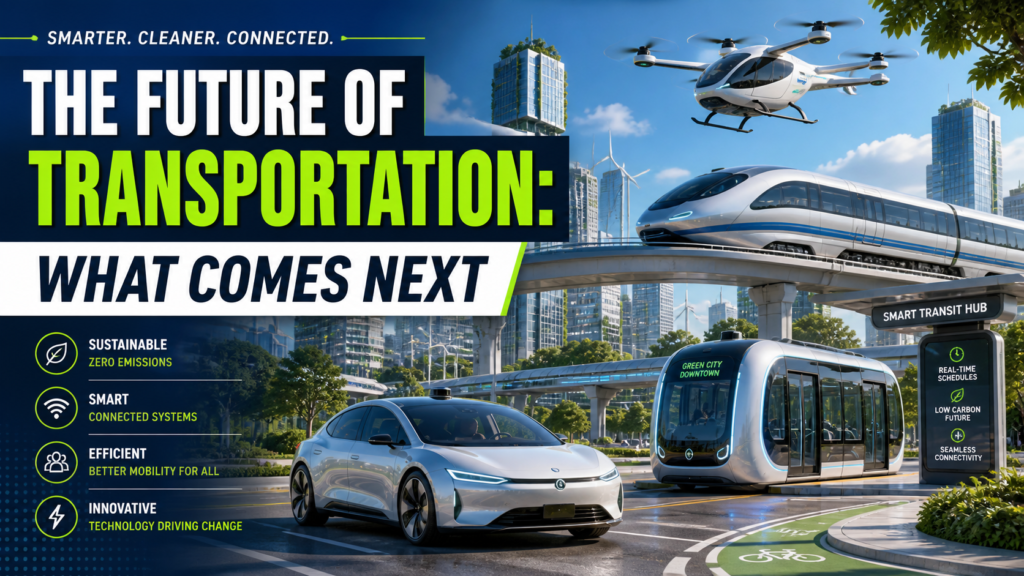
The Future of Transportation: What Comes Next

Explore the future of transportation — from self-driving cars and flying taxis to hyperloops and green energy vehicles. Discover what’s coming next in 2025 and beyond. TABLE OF CONTENTS 1. Introduction 2. Why the Future of Transportation Matters ■ The global transport crisis ■ Environmental and economic stakes 3. Self-Driving Cars and Autonomous Vehicles ■ How autonomous vehicles work ■ Real-world examples today 4. Electric Vehicles: Powering Tomorrow’s Roads ■ EV market growth statistics ■ Charging infrastructure challenges 5. Hyperloop: The 700 mph Dream ■ How hyperloop technology works ■ Current hyperloop projects worldwide 6. Urban Air Mobility and Flying Taxis ■ eVTOL technology explained ■ Companies leading the skies 7. Smart Cities and Connected Transportation 8. Sustainable Transportation and Green Mobility 9. Mobility as a Service (MaaS): The Subscription Era 10. Expert Tips: How to Prepare for the Transport Revolution 11. Common Mistakes People Make About Transport Futures 12. FAQ – People Also Ask 13. Media, Internal Links & Authority Sources 14. Conclusion + Call to Action 1. Introduction Imagine opening your front door, tapping your phone, and watching a flying taxi arrive just a few minutes later. You step inside, lift above the crowded streets, and reach the other side of the city without sitting in traffic for even a second. A few years ago, this sounded like something from a science-fiction movie. Today, it feels much closer to reality. Transportation is changing faster than many people realise. The way we travel affects almost every part of modern life — the quality of the air we breathe, how much time we lose in traffic, how easily goods reach our homes, how cities grow, and how much carbon we release into the atmosphere. From electric vehicles and self-driving cars to high-speed rail, delivery drones, and smart traffic systems, a new mobility revolution is already underway. This transformation is being powered by major advances in artificial intelligence, battery storage, clean energy, aerospace design, and digital infrastructure. Together, these technologies are creating a future where transportation could become cleaner, faster, safer, and more connected than ever before. In this guide, we will explore the biggest trends shaping the future of transportation. You will learn how new technologies are changing the movement of people and goods, what real-world examples are already emerging, and what these changes could mean for everyday life, businesses, cities, and the global economy. Whether you are a student, investor, city planner, technology enthusiast, or simply a curious reader, this article will help you understand what is coming next — and why it matters. 2. Why the Future of Transportation Matters Transportation keeps the modern world moving. From the food we buy at supermarkets to the daily commute, online deliveries, emergency services, and global trade, almost everything depends on reliable transport networks. But the systems we use today are facing growing strain. 2.1 The Global Transport Challenge Around the world, transportation is becoming more expensive, crowded, and environmentally damaging. Traffic jams waste billions of hours every year. Cars, trucks, ships, and planes continue to produce a large share of global emissions. Cities are becoming more crowded, placing even more pressure on roads, railways, and public transit. At the same time, road accidents remain one of the biggest causes of preventable deaths worldwide. Recent data shows how serious the problem has become: Traffic congestion costs the U.S. economy tens of billions of dollars every year. The transport sector produces nearly one-quarter of global carbon dioxide emissions. By 2050, most of the world’s population is expected to live in urban areas, increasing the demand for faster and smarter mobility. Road accidents claim more than a million lives globally each year. These facts point to one major conclusion: the traditional transportation model is no longer enough. It is not clean enough, safe enough, or efficient enough for the future. The positive side is that change is already happening. Governments, technology companies, engineers, and entrepreneurs are now working on new solutions that could make transportation safer, greener, and far more intelligent. 2.2 Environmental and Economic StakesDecarbonising transport is not optional if the world is to meet its climate targets. The InternationalThe Energy Agency estimates that electric vehicles, cleaner fuels, and smarter logistics must togethereliminate at least 50% of transport emissions by 2030 to stay on a net-zero pathway. At the sametime, smart mobility solutions could unlock trillions of dollars in economic value through savedcommute time, lower fuel costs, and reduced infrastructure spending 3. Self-Driving Cars and Autonomous Vehicles Autonomous vehicles are one of the most important parts of the future transportation conversation. The idea is simple but powerful: if vehicles can drive themselves safely, they could reduce human mistakes, improve traffic flow, lower fuel waste, and make travel more efficient. 3.1 How Autonomous Vehicles Work Self-driving vehicles use a combination of advanced hardware and intelligent software to understand the road around them. Instead of relying on a human driver’s eyes and reactions, these systems collect information from multiple sources simultaneously. LiDAR helps the vehicle build a detailed 3D picture of its surroundings. Radar detects nearby objects and measures their speed, even in rain, fog, or low light. High-resolution cameras identify road signs, lane markings, traffic signals, pedestrians, and other vehicles. Artificial intelligence then studies all this information in real time and decides when to brake, turn, slow down, or change lanes. Many autonomous vehicles also use high-definition maps, which help them know their exact position on the road with impressive accuracy. Automation is usually measured in levels. SAE International describes these levels from Level 0, where the human does everything, to Level 5, where the vehicle can drive completely on its own in every situation. At the moment, most systems available to consumers are still in the middle range. They can assist with steering, braking, acceleration, and some driving tasks, but they still need a human driver to stay alert and take control when required. ■ INTERNAL LINK IDEAS ANCHOR TEXT / PAGE Description EV Buying Guide 2025 Link from ‘electric vehicles’

The Future of Transportation: What Comes Next Read More »

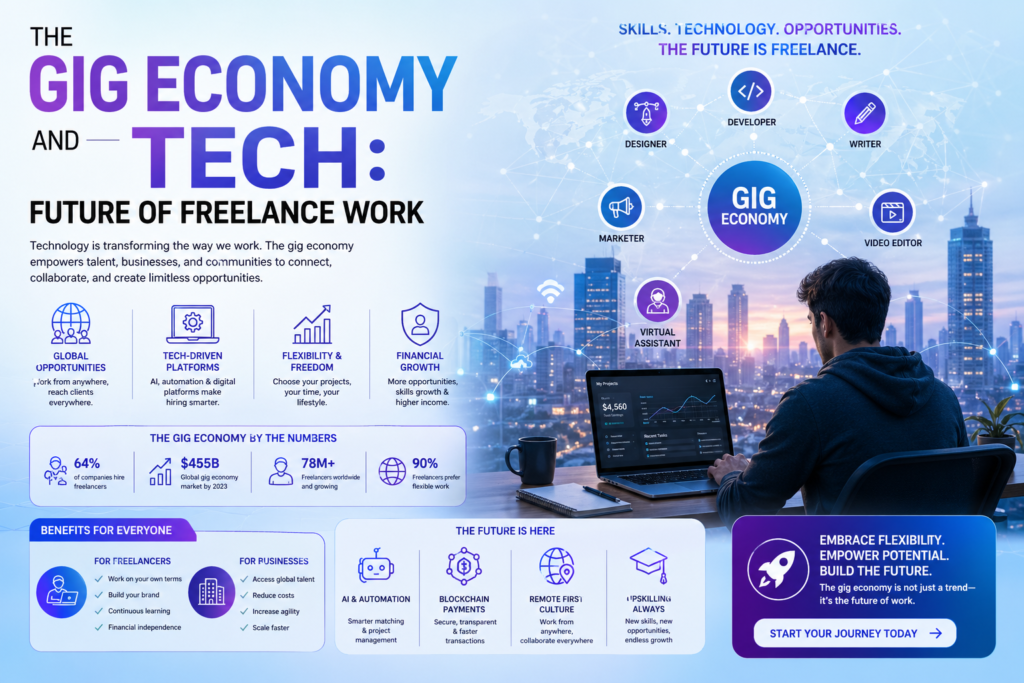
The Gig Economy and Tech: Future of Freelance Work

The Gig Economy and Tech: Future of Freelance Work in 2026

Table of Contents 1. Introduction — The New World of Work 2. What Is the Gig Economy? A Clear Definition 3. How Technology Powers the Gig Economy 4. Top Gig Economy Platforms Driven by Tech 5. Key Statistics: The Gig Economy by the Numbers 6. Benefits of the Gig Economy and Tech Convergence 7. Challenges Facing Gig Workers in the Digital Age 8. The Future of Work: Where the Gig Economy Is Heading 9. Expert Tips for Thriving as a Gig Worker 10. Common Mistakes Gig Workers Make (and How to Avoid Them) 11. FAQ — People Also Ask 12. Conclusion & Call to Action 13. Media, Internal & External Link Recommendations 1. Introduction — The New World of Work Picture this: you wake up, grab your phone, and decide what kind of work you want to do today. No manager checking in, no fixed schedule, no rush-hour traffic. For more than 1.5 billion people worldwide, this isn’t a fantasy—it’s daily life. The rise of the gig economy, powered by rapid technological advancement, is transforming how people earn a living. From freelance developers and graphic designers to delivery drivers and online tutors, millions now rely on digital platforms to find work and get paid. Technology sits at the center of it all—mobile apps connect workers with clients, AI tools match skills to tasks, and digital payment systems ensure quick, seamless transactions across borders. What started as a flexible side hustle has grown into a massive global market worth hundreds of billions of dollars—and it’s still expanding. This shift is not just changing jobs; it’s redefining the very concept of employment. In this article, we’ll explore how technology and the gig economy are shaping each other, what this means for both workers and businesses, and how you can take advantage of the opportunities while avoiding common pitfalls. By the end, you’ll have a clear understanding of where this trend is heading—and how to stay ahead of it. 2. What Is the Gig Economy? A Clear Definition The term gig economy refers to a labor market where short-term contracts and freelance work replace traditional permanent employment. Instead of a 9-to-5 job with a single employer, workers take on multiple assignments — or ‘gigs’ — often through digital platforms. The gig economy covers three broad categories: Category Description Example On-demand services Immediate local task fulfillment TaskRabbit, DoorDash, Postmates Platform-based Work sourced through apps or websites Uber, Fiverr, Upwork Freelance / Contract Independent professional services Copywriting, Web Dev, Design 3. How Technology Powers the Gig Economy 3.1 Mobile Apps and On-Demand Platforms The smartphone revolution made gig work accessible to anyone, anywhere. Mobile apps like Uber, Lyft,Instacart and Fiverr allow workers to sign up, get verified, and start earning within hours. Real-time GPS, pushnotifications, and in-app communication make the logistics of on-demand work seamless for both workers andclients. 3.2 Artificial Intelligence and Smart Matching Artificial intelligence works quietly behind the scenes of most major gig platforms. It processes data such as user profiles, past ratings, location, and availability to connect workers with suitable opportunities. This intelligent system helps clients find the right talent faster, enables workers to access more relevant jobs, and improves the platform’s overall efficiency. ■ Personalized job recommendations based on skills and history■ Dynamic pricing models (surge pricing) that respond to real-time demand■ Fraud detection and identity verification for platform safety■ Customer review systems that build digital reputation and trust 3.3 Cloud Computing and Remote Collaboration Cloud-based platforms such as Google Workspace, Notion, Slack, Zoom, and GitHub make it possible for freelancers to work seamlessly with clients from anywhere in the world. These tools remove the need for physical presence, enabling real-time communication, file sharing, and project management across different time zones. At the same time, cloud storage keeps important documents, project files, and deliverables securely stored, easy to access, and well-organized at all times. 3.4 Digital Payments and Financial Technology Receiving payments was once one of the biggest challenges for freelancers, often involving delays, high fees, and complicated processes. Today, financial technology has made it much smoother. Services like PayPal, Stripe, and Wise, along with cryptocurrency wallets, enable fast and seamless transactions across borders. In addition, many platforms now include built-in features such as escrow protection, automated invoicing, and tax management tools, making it much easier for freelancers to handle their finances efficiently. 3.5 Blockchain and Smart Contracts New advances in blockchain are beginning to change how trust works in the gig economy. With smart contracts, payments can be triggered automatically once agreed conditions are met and recorded on the blockchain. This reduces reliance on middlemen, minimizes disputes, and creates a more transparent and reliable payment system for freelancers across the globe. 4 . Top Gig Economy Platforms Driven by Tech 5. Key Statistics: The Gig Economy by the Numbers Numbers tell the real story of how massive and fast-moving the gig economy and tech convergence truly is 6. Benefits of the Gig Economy and Tech Convergence The marriage of the gig economy and tech creates value for workers, businesses, and entire economies. Here is a balanced look at the key advantages: For Workers ✔ Flexibility: Work when, where, and how much you want. Studies show flexibility is the #1 reason workers choose gig roles. ✔ Global clients: Tech platforms remove geographic barriers — a developer in Pakistan can easily serve clients in the United States. ✔ Income diversification: Workers can combine multiple gigs to build a stable, diverse income stream. ✔ Skill monetization: Niche skills that were hard to market locally are now globally sellable. ✔ Low entry barriers: Starting is fast — create a profile, list your skills, and begin earning within days. For Businesses ✔ Cost efficiency: Hire project-based talent instead of full-time employees, reducing overhead significantly. ✔ Speed: Access vetted, skilled professionals within hours rather than weeks. ✔ Scalability: Scale your workforce up or down based on project demand without HR complexity. ✔ Innovation: Fresh external perspectives from gig workers often inject new ideas into

The Gig Economy and Tech: Future of Freelance Work in 2026 Read More »

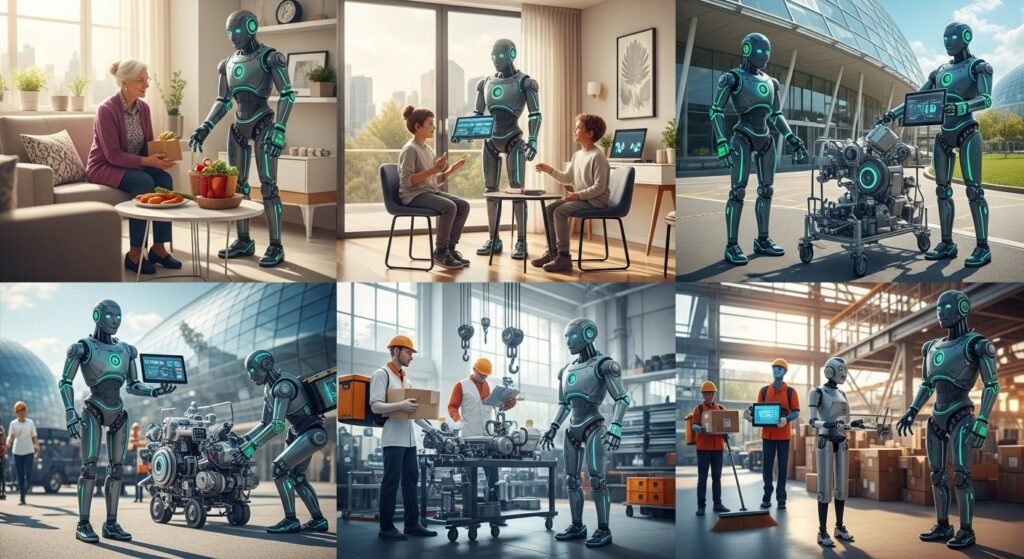
Humanoid Robots: The Future of AI and Automation

Humanoid Robots: The Future of AI and Automation

 Discover how humanoid robots are transforming industries, daily life, and the future of work. Explore top models, use cases, benefits, and what experts say. Humanoid Robots: The Future of AI and Automation in 2026 and Beyond Humanoid robots are no longer science fiction. They are walking into warehouses, hospitals, and research labs right now. In 2025, the race to build the perfect human-like robot has reached a fever pitch — and the implications for every industry on the planet are staggering. From Tesla’s Optimus to Boston Dynamics’ Atlas, humanoid robots are being designed to think, move, and work alongside humans. According to Goldman Sachs, the humanoid robot market could reach $38 billion by 2035. That number alone tells you just how seriously the world is taking this technology.In this guide, we break down everything you need to know about humanoid robots — what they are, how they work, who is building them, what they cost, and what the future looks like. Whether you are a tech enthusiast, a business owner, or just curious, this article has answers. Table of Contents 1. What Are Humanoid Robots? A humanoid robot is a robot that closely resembles the human body in shape and function. It typically has a head, torso, two arms, and two legs. These machines are designed to interact with human environments — using the same tools, navigating the same spaces, and sometimes performing the same tasks. Unlike traditional industrial robots that are bolted to factory floors, humanoid robots are mobile. They can walk, climb stairs, pick up objects, and even make decisions using artificial intelligence. Key Characteristics of Humanoid Robots The term ‘android’ is sometimes used for humanoid robots that look extremely human-like, though in engineering, the two terms are often used interchangeably. The primary goal is the same: build a machine that can operate in any environment built for humans. 2. How Do Humanoid Robots Work? Building a humanoid robot is one of the hardest engineering challenges in the world. It requires advances across multiple disciplines — mechanics, electronics, computer vision, and artificial intelligence — all working together in real time. The Core Systems Behind Humanoid Robots A key insight from researchers at MIT’s Computer Science and Artificial Intelligence Laboratory (CSAIL): the hardest part is not making a robot move — it is making it move intelligently in unpredictable environments. That is where AI integration becomes the true differentiator. 3. Top Humanoid Robot Companies in 2025 The humanoid robotics space is crowded and competitive. These are the companies leading the charge right now. Tesla — Optimus Elon Musk’s Tesla entered the humanoid robot race officially in 2022 and has moved fast. The Optimus robot (also called Tesla Bot) is designed for general-purpose labor. As of 2025, Optimus Gen 2 stands 5’8″, weighs 128 lbs, and can walk at 5 mph. Tesla is targeting a price below $20,000 for mass production. The robot uses Tesla’s FSD (Full Self-Driving) AI stack, making it one of the most software-advanced units in development. Boston Dynamics — Atlas Boston Dynamics has been building robots since 1992 and is widely considered the industry pioneer. The electric Atlas robot (third generation) is arguably the most mechanically capable humanoid robot in the world. Atlas can perform backflips, parkour, and precise manipulation tasks. Boston Dynamics transitioned Atlas to commercial use in 2024, partnering with manufacturers for real-world deployment. Figure AI — Figure 01 and Figure 02 Figure AI, backed by investors including Microsoft, OpenAI, and Jeff Bezos, has raised over $700 million. Their Figure 02 robot integrates OpenAI’s GPT-4 model for natural language understanding. In early demos, Figure 02 demonstrated real-time reasoning and task completion in a way no previous commercial robot had achieved. Agility Robotics — Digit Agility Robotics partnered with Amazon to deploy its Digit robot in fulfillment centers. Digit focuses on logistics tasks — picking up totes, moving materials, and working alongside human employees. Amazon’s warehouse deployment is one of the first large-scale real-world tests of humanoid robots in industrial settings. Unitree Robotics — H1 and G1 China-based Unitree has positioned itself as the affordable alternative. The Unitree G1 humanoid robot starts at approximately $16,000 — a fraction of the cost of competitors. While it lacks some advanced capabilities, Unitree’s pricing strategy could be a major disruptor in making humanoid robots accessible to smaller companies. Internal Link Suggestions Recommended External Authority Sources

Humanoid Robots: The Future of AI and Automation Read More »

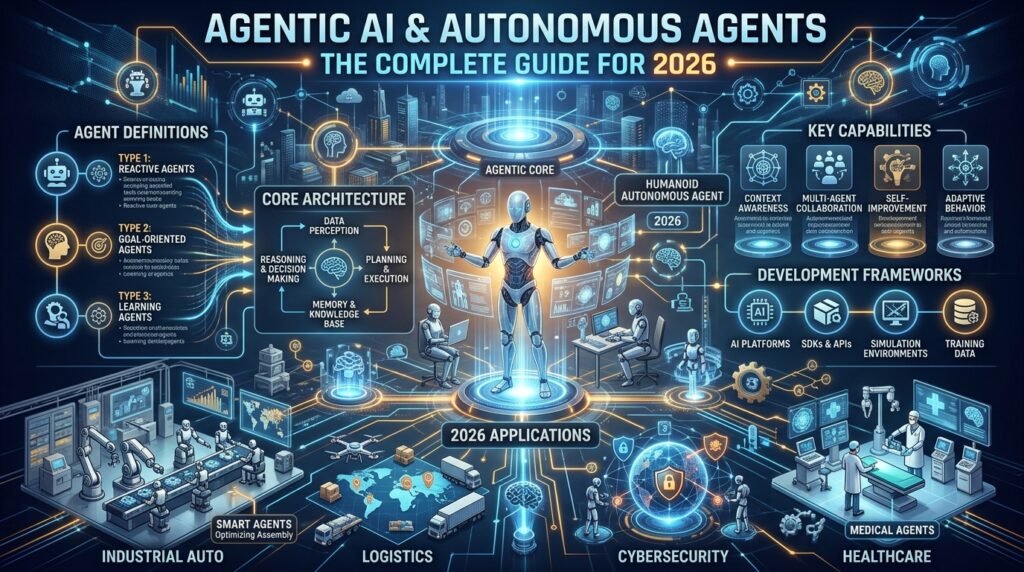
Agentic AI & Autonomous Agents

Agentic AI & Autonomous Agents: The Complete Guide for 2026

What if your AI didn’t just answer questions — but actually got things done on its own? That’s the promise of agentic AI & autonomous agents — and it’s no longer science fiction. In 2026, these intelligent systems are reshaping industries, automating complex workflows, and making decisions that once required human judgment. Whether you’re a developer, business owner, or tech enthusiast, understanding agentic AI is no longer optional. It’s essential. In this guide, you’ll discover exactly what agentic AI & autonomous agents are, how they work, who’s using them, and where they’re headed. Let’s dive in. Table of Contents 1. What Are Agentic AI & Autonomous Agents? Agentic AI refers to AI systems that can autonomously pursue goals, make decisions, and take sequences of actions in the real world — without needing a human to direct every step. Unlike traditional AI tools that respond to a single input and stop, an agentic system can plan ahead, use tools, and adapt its strategy based on results. Think of it this way: a regular AI chatbot is like a vending machine — you press a button and get one result. An agentic AI is more like a smart employee — you give it an objective, and it figures out how to achieve it. Agentic AI vs. Traditional AI EXPERT INSIGHTThe real breakthrough in agentic AI is not the LLM itself — it is the orchestration layer. Toolslike LangGraph, CrewAI, and AutoGen allow developers to build reliable, multi-agentpipelines that can handle real business complexity. Image 2: Multi-agent system architecture with manager and worker agents. ALT: “Multi-agent AI system architecture diagram.” Image 3: Comparison infographic: AI Agent vs Chatbot vs Traditional Automation. ALT: “Agentic AI vs Chatbot vs. traditional automation comparison.” Image 4: Bar chart of agentic AI market growth 2023-2027. ALT: “Autonomous AI agents market growth Statistics 2026″ Image 5: Screenshot of an AI agent completing a research task in real-time. ALT: “Autonomous AI agent completing research task example.” Internal Link Ideas 12. Media Optimization & Link StrategySuggested Images (with ALT Text) → What is a Large Language Model (LLM)? Beginner’s Guide → Best AI Tools for Business Productivity in 2026 → How to Use LangChain for AI Automation (Step-by-Step) → AI vs Machine Learning vs Deep Learning: Key Differences → Top 10 AI Trends Shaping Enterprise Technology in 2026 External Authority Sources MarketsandMarkets — AI Agents Global Market Report 2024–2027 (marketsandmarkets.com) Stanford HAI — Human-Centered AI research on agentic systems (hai.stanford.edu) MIT Technology Review — ‘The Rise of AI Agents’ (technologyreview.com)

Agentic AI & Autonomous Agents: The Complete Guide for 2026 Read More »

How Big Tech Is Preparing for Quantum Cybersecurity Threats

How Big Tech Is Preparing for Quantum Cybersecurity Threats

Table of Contents Introduction — The Quantum Clock Is Ticking How Big Tech Is Preparing for Quantum Cybersecurity Threats is one of the most urgent questions in modern technology today. The digital world runs on encryption. Every bank transfer, private message, medical record, and government file is protected by cryptographic algorithms that have kept us safe for decades. But that safety has an expiry date — and quantum computing may be setting that clock. Quantum computers are no longer a science-fiction concept. They are real, they are advancing fast, and they have the potential to break the RSA and ECC encryption standards that protect most of the internet today. In response, Big Tech companies — Google, IBM, Microsoft, Amazon, and others — are investing billions of dollars into quantum-safe cryptography and post-quantum encryption strategies. According to a 2024 report by McKinsey Quantum computing investment surpassed $2.35 billion globally in 2023, with a significant portion directed at cybersecurity preparedness. 2024 report by McKinsey, quantum computing The race is not just about building the most powerful quantum computer — it is about making sure that when one arrives, our data remains safe 2. What Is the Quantum Cybersecurity Threat? The Encryption Problem | Modern encryption — such as RSA-2048 and Elliptic Curve Cryptography (ECC) — relies on mathematical problems that are extremely hard for classical computers to solve. Factoring a 2,048-bit number, for example, would take a classical computer millions of years. A sufficiently powerful quantum computer running Shor’s algorithm, however, could solve the same problem in hours or even minutes. This means: SSL/TLS certificates protecting websites could be broken. VPN tunnels and encrypted communications could be exposed. Digital signatures on financial transactions could be forged. Government and military communications could be decrypted.   How Close Are We to a Cryptographically Relevant Quantum Computer? Experts estimate that a cryptographically relevant quantum computer (CRQC) — one powerful enough to break current encryption — could arrive anywhere between 2030 and 2040, though some researchers believe a surprise breakthrough could move that timeline earlier. IBM’s 2023 quantum roadmap projects systems exceeding 100,000 qubits by 2033, and error-correction advances are accelerating rapidly. 3. Why Big Tech Is Taking This Seriously Right Now Long Migration Timelines Replacing encryption standards across global infrastructure is not a one-day job. It took the industry more than 15 years to transition from SHA-1 to SHA-256. Migrating to post-quantum cryptography across banks, hospitals, government systems, cloud services, and IoT devices will take at least as long — possibly longer. The Harvest Now, Decrypt Later (HNDL) Attack Nation-state actors are already collecting encrypted data today with the intent to decrypt it once quantum computers become powerful enough. This strategy — known as Harvest Now, Decrypt Later — means that data encrypted today with classical methods is already at risk for future exposure. Sensitive data with a long shelf life (medical records, national security files, intellectual property) is especially vulnerable. 4. Google’s Quantum Security Strategy Jan 2021Company EstablishedFIDO2 and Post-Quantum Hybrid Keys In 2023, Google announced updates to its FIDO2 security key implementation to include hybrid post-quantum cryptography. This means security keys now use both classical and quantum-resistant algorithms simultaneously — providing protection even if one method is compromised. New office in CaliforniaChrome and TLS 1.3 Post-Quantum Extensions Google began testing post-quantum key encapsulation in Chrome 116 using the X25519Kyber768 algorithm — a hybrid that combines a classical Diffie-Hellman key exchange with CRYSTALS-Kyber, one of NIST’s approved post-quantum algorithms. This protects users’ HTTPS browsing sessions from future quantum attacks. Google's Willow Quantum Chip Google began testing post-quantum key encapsulation in Chrome 116 using the X25519Kyber768 algorithm — a hybrid that combines a classical Diffie-Hellman key exchange with CRYSTALS-Kyber, one of NIST’s approved post-quantum algorithms. This protects users’ HTTPS browsing sessions from future quantum attacks. Google's Willow Quantum Chip In December 2024, Google unveiled its Willow quantum chip, which achieved a computation in five minutes that would take a classical supercomputer an astronomically long time. While still not a threat to encryption, Willow demonstrates the pace of advancement — and underscores why Google is building defenses now. 5. IBM’s Post-Quantum Cryptography Roadmap Click Here Expert Tips for Businesses Preparing for Quantum Threats ■ Conduct a Cryptographic Inventory Map every system, application, and data flow that uses encryption. Tools like IBM’s Cryptography Bill of Materials (CBOM) can help automate this. ■ Prioritize Long-Lived Data Identify data that must remain confidential for 10+ years. This data is most at risk from HNDL attacks and should be migrated to post-quantum encryption first. ■ Adopt Crypto-Agility Build systems that can swap encryption algorithms without major re-architecture. Crypto-agility is the key design principle for quantum readiness. ■ Follow NIST Standards Implement FIPS 203 (ML-KEM) and FIPS 204 (ML-DSA) as your primary post-quantum algorithms. Avoid proprietary or unvetted quantum-safe solutions. Map every system, application, and data flow that uses encryption. Tools like IBM’s Cryptography Bill of Materials (CBOM) can help automate this. Identify data that must remain confidential for 10+ years. This data is most at risk from HNDL attacks and should be migrated to post-quantum encryption first. Build systems that can swap encryption algorithms without major re-architecture. Crypto-agility is the key design principle for quantum readiness. Implement FIPS 203 (ML-KEM) and FIPS 204 (ML-DSA) as your primary post-quantum algorithms. Avoid proprietary or unvetted quantum-safe solutions. Common Mistakes Organizations Make on Quantum Security ■■ Mistake #1: Waiting for the Threat to Arrive Many security teams say ‘we’ll deal with it when quantum computers are here.’ This ignores HNDL attacks and the decade-long migration timeline. ■■ Mistake #2: Confusing Quantum Computing with Quantum Communication Quantum Key Distribution (QKD) is sometimes mistakenly treated as a complete solution. QKD secures key exchange but does not replace the need for post-quantum cryptographic algorithms in software. ■■ Mistake #3: Deploying Unvetted Quantum-Safe Algorithms Some vendors offer proprietary ‘quantum-resistant’ algorithms that have not been peer-reviewed. Only use algorithms validated through NIST’s process. ■■ Mistake #4: Ignoring Legacy Systems Old infrastructure — mainframes, embedded systems, industrial controllers

How Big Tech Is Preparing for Quantum Cybersecurity Threats Read More »

Benefits of Remote Work for Employees

The Evolution of Remote Work

  The Rise of Remote Work: Complete Guide 2026 How Flexible Work Is Redefining Careers, Businesses, and the Global Economy Picture this: you wake up, make your coffee, sit down with your laptop, and begin your workday without traffic, office noise, or strict schedules. For millions of people today, this is no longer a fantasy. It is everyday life. Remote work has rapidly shifted from a rare workplace benefit to a global standard. What once existed mainly in tech circles has now spread across industries, countries, and job roles. The turning point came during the COVID-19 pandemic, which accelerated workplace transformation at an unprecedented pace. Changes that might have taken a decade happened in just a year and a half. Research from workplace experts such as Stanford economist Nicholas Bloom shows that remote work increased sharply during the pandemic and has stayed far above previous levels ever since. This is not a temporary trend. It represents a long-term structural shift in how work is done. In this guide, we will break down everything you need to know: how remote work evolved, why it grew so fast, its benefits and challenges, and what the future may look like. Table of Contents A Short History of Remote Work Key Statistics That Define the Trend Why Remote Work Expanded So Quickly Benefits for Employees Benefits for Employers Challenges of Remote Work The Hybrid Work Model Productivity: Myth vs Reality Essential Tools The Future of Remote Work A Short History of Remote Work Remote work did not begin with laptops or Wi-Fi. Its roots go much further back. In the 1970s, the idea of telecommuting was introduced as a way to move work to people instead of forcing people to travel to work. At the time, the concept sounded futuristic and was limited to only a few industries. By the 1990s and early 2000s, the internet changed the possibilities. Email, file sharing, and early video calls made long-distance collaboration more practical. During the 2010s, startups and digital-first companies proved that distributed teams could perform successfully without a traditional office. Then came 2020. The pandemic forced businesses worldwide to adopt remote work almost overnight. Many companies expected productivity to collapse, but in many cases, the opposite happened. Teams adapted, tools improved, and employees began to question whether the old office routine was truly necessary. Key Statistics That Define the Trend The numbers clearly show that remote work is not fading. A large share of knowledge workers now work remotely at least part-time. Remote job listings often attract far more applicants than traditional office roles. Most employees say they want at least some flexibility in where they work. Many knowledge workers now work remotely or in hybrid arrangements. Remote roles often receive stronger applicant interest. Employees save time and money by reducing commuting. Companies can reduce office costs and access wider talent pools. Productivity can improve when remote work is managed properly. This data points to one clear conclusion: remote work has become a permanent part of the modern employment landscape. Why Remote Work Expanded So Quickly 1. The Pandemic Effect COVID-19 removed hesitation almost instantly. Businesses that had resisted remote work for years suddenly had to make it work. The global experiment proved that many tasks could be completed effectively outside the office. 2. Technology Readiness Cloud platforms, video calls, messaging apps, project management systems, and digital security tools were already mature enough to support remote teams. The technology was ready when the demand arrived. 3. Global Talent Access Companies realized that they no longer had to hire only within commuting distance. Remote work allowed them to recruit skilled professionals from different cities, countries, and time zones. 4. Cost Reduction Large offices are expensive. Remote and hybrid models help businesses reduce rent, utilities, maintenance, and other operational expenses. 5. Changing Worker Priorities Employees increasingly value flexibility, autonomy, and balance. For many workers, the option to work remotely has become a major factor when choosing a job. Benefits of Remote Work for Employees Remote work gives employees more control over their time, environment, and daily routine. Removing the commute alone can return hundreds of hours per year. Those hours can be used for family, health, learning, rest, or focused work. Time savings: Less time spent in traffic or public transport. Lower expenses: Reduced spending on fuel, meals, clothing, and commuting. Better focus: Fewer office interruptions for many workers. Location freedom: More choice over where to live and work. Improved balance: Easier management of personal and professional responsibilities. Benefits of Remote Work for Employers Employers also gain major advantages from remote work. Businesses can reduce overhead, attract stronger candidates, improve retention, and build more flexible operations. For companies competing for specialized talent, remote hiring can be a strategic advantage. Reduced office and operational costs Access to a wider talent pool Higher employee satisfaction and retention Potential productivity gains in focused roles Better coverage across multiple time zones Challenges of Remote Work Remote work has benefits, but it is not perfect. Without intentional systems, it can create isolation, communication gaps, blurred boundaries, and visibility issues. Isolation Without daily office interaction, employees may feel disconnected. Virtual coffee chats, coworking spaces, and team rituals can help rebuild social connection. Work-Life Blur When home becomes the office, it can be difficult to switch off. A dedicated workspace, clear start and stop times, and notification boundaries can protect personal time. Communication Issues Remote teams need clear writing, documented decisions, and regular check-ins. Good communication is the foundation of remote success. Security Risks Remote access can create cybersecurity concerns. Companies should use strong passwords, multi-factor authentication, VPNs, and secure devices. The Hybrid Work Model Many organizations now prefer a hybrid model, where employees split time between home and the office. This approach attempts to combine the focus of remote work with the collaboration of in-person meetings. Common hybrid setups include fixed office days, team anchor days, remote-first policies with optional office use, and role-based flexibility. The best model depends on the company,

The Evolution of Remote Work Read More »