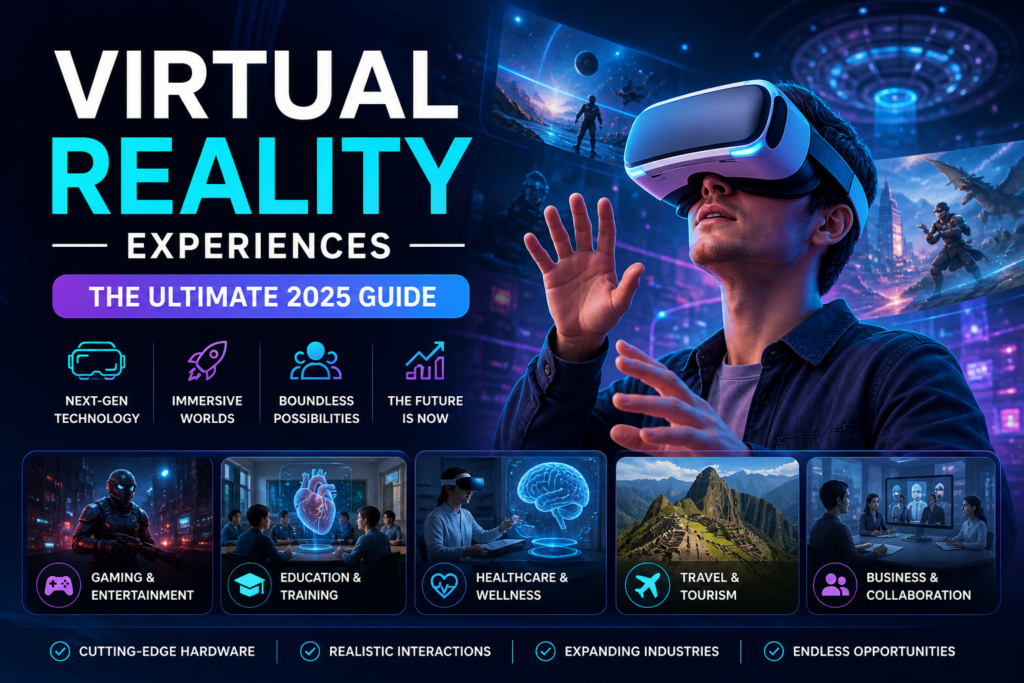
Virtual Reality Experiences: The Ultimate 2025 Guide
Table of Contents 1. What Are Virtual Reality Experiences? 2. The Global VR Market: Key Statistics & Growth 3. Types of Virtual Reality Experiences 4. Top Industries Using VR Technology 5. Best VR Headsets for Every Budget 6. Virtual Reality Gaming: A Revolution in Play 7. VR in Education: Learning Like Never Before 8. VR in Healthcare: Healing Through Immersion 9. Metaverse Experiences & Social VR 10. Expert Tips for the Best VR Experiences 11. Common Mistakes to Avoid in VR 12. FAQs — People Also Ask 13. Conclusion & Call to Action 14. Media Suggestions, Internal & External Links Introduction Imagine standing on the summit of Mount Everest without leaving your living room, or performing a complex surgery simulation before ever touching a real patient. That is the transformative power of virtual reality experiences — and in 2025, this technology is no longer science fiction. It is a fast-growing reality reshaping how we work, learn, heal, and play. Virtual reality experiences have exploded from niche gaming gadgets into a multi-billion-dollar industry ecosystem spanning healthcare, education, real estate, retail, and the metaverse. Whether you are a developer, a business owner, a student, or simply a curious consumer, understanding VR in depth can open doors you never knew existed. This comprehensive guide covers everything you need to know about virtual reality experiences in 2025 — the best devices, the most impactful use cases, expert tips, and what the future holds for this Incredible technology. $57.6B $435B Global VR Market Size 2023 Projected Market Size by 2030 1. What Are Virtual Reality Experiences? Virtual reality experiences are computer-generated, three-dimensional environments that users caninteract with in a seemingly real or physical way. Using a VR headset — sometimes paired with motioncontrollers, haptic gloves, or treadmills — people become fully immersed in a digital world that reacts to their movements and actions. Core Components of a VR Setup 2. The Global VR Market: Key Statistics & Growth The numbers behind virtual reality experiences speak for themselves. This technology has moved from a developer’s experiment to a mainstream commercial powerhouse. ■ The global VR market was valued at $57.6 billion in 2023 and is projected to reach $435billion by 2030 (Grand View Research, 2024). ■ VR gaming alone accounts for over 38% of total VR market revenue worldwide. ■ Healthcare VR applications are the fastest-growing segment, with a 42% CAGR through 2028. ■ Over 130 universities across the US and Europe have adopted VR-based learning modules as of 2024. ■ 65% of Fortune 500 companies have tested or deployed VR for employee training (PwC,2023). These numbers confirm one undeniable truth: virtual reality experiences are not a passing trend. They are a foundational technology of the next decade. 10. Expert Tips for the Best VR Experiences ■ Expert VR Tips for Beginners • Start with short 10–15 minute sessions to build your VR legs and avoid motion sickness. • Always play in a clear, open space at least 2m × 2m. Use boundary guardian settings. • Adjust IPD (interpupillary distance) on your headset for maximum clarity and comfort. • Use headphones for spatial audio — sound direction is a core part of immersion. • Keep your lenses clean. Smudges break immersion and cause eye strain. • Hydrate before extended VR sessions and take breaks every 20–30 minutes. • For roomscale VR, use an anti-fatigue mat to protect your joints during long play. ■ Advanced Tips for Developers & Creators • Design for 90+ FPS. Frame drops below 72 FPS cause immediate discomfort. • Use teleportation locomotion as an option — it drastically reduces motion sickness. • Optimize polygon count aggressively — VR renders two eyes simultaneously. • Use spatial audio APIs (Steam Audio, Meta Resonance) for realistic sound positioning. • Test with real users early and often — VR UX intuitions differ from desktop UX. 11. Common Mistakes to Avoid in VR ■■ Common Mistakes to Avoid ✗ Playing VR without setting up a safety boundary leads to bumping into walls and furniture. ✗ Ignoring IPD calibration causes headaches, blurred visuals, and eye fatigue.✗ Buying a PC VR headset without checking your GPU requirements first. ✗ Overlooking hygiene — VR face gaskets collect sweat and bacteria. Clean regularly. ✗ Jumping into intense VR games first — start with calm experiences to build tolerance. ✗ Using VR in direct sunlight — it can damage OLED displays permanently. ✗ Ignoring age guidelines — most headsets are not recommended for children under 12. ✗ Expecting console VR quality on budget standalone headsets — set realistic expectations. 12. FAQs — People Also Ask Q: What are the best virtual reality experiences for beginners? A: For beginners, the best virtual reality experiences are on the Meta Quest 3. Start with Beat Saber for fun fitness gameplay, Google Earth VR for awe-inspiring exploration, and Superhot VR for mind-bending action. These titles are intuitive, comfortable, and deliver an immediate ‘wow’ factor without overwhelming first-time users. Q: Can virtual reality experiences cause motion sickness? A: Yes, some users experience VR motion sickness — often called ‘cybersickness’ or VR nausea. It occurs when your eyes see movement but your body does not feel it. To minimize it: start with short sessions, use teleportation locomotion, ensure high frame rates (90+ FPS), and gradually build your tolerance over days or weeks. Q: How much does a quality VR setup cost? A: A quality standalone VR setup starts at around $299–$499 (Meta Quest 2 or 3). A PC-powered premium setup costs $800–$2,000+. Enterprise and professional setups (Apple Vision Pro, full haptic suits) can exceed $5,000. For most users, the Meta Quest 3 at $499 offers the best value for money in 2025. Q: Is virtual reality good for education and learning? A: Absolutely. Research shows VR learners retain information 75% better than those using traditional e-learning methods. VR creates emotionally engaging environments that trigger deeper memory formation. Applications like Labster, Engage, and zSpace are already used in thousands of schools and universities globally.Q: What is the difference
Virtual Reality Experiences: The Ultimate 2025 Guide Read More »