
Introduction
Have you ever typed a question into ChatGPT and gotten a confusing
or useless answer? The problem usually isn’t the AI. It’s the prompt.
Prompt engineering is the skill of writing clear instructions so an AI
model understands exactly what you want. It sits at the crossroads of
language, logic, and technology. And in 2026, it’s quickly becoming
one of the most valuable skills anyone can learn, whether you’re a
student, marketer, developer, or business owner.
In this guide, you’ll learn what prompt engineering really means, why
it matters, and how to do it well. We’ll cover real examples, expert
tips, common mistakes, and answers to the questions people search
for most. By the end, you’ll be able to write prompts that get sharper,
faster, and more useful results from any AI tool
What Is Prompt Engineering?
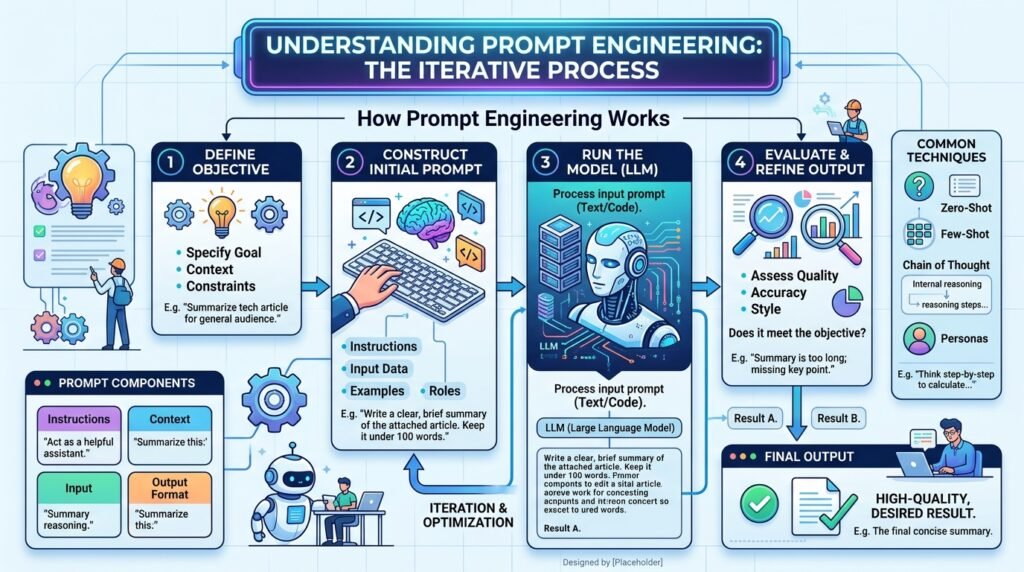
Prompt engineering is the process of designing and refining the text
input, or “prompt,” that you give to an AI model to produce the best
possible output. Think of it as learning how to ask better questions so
you get better answers.
An AI model like ChatGPT, Claude, or Gemini doesn’t read your mind.
It reads your words. The way you phrase a request directly shapes the
quality, tone, and accuracy of the response you get back.
At its core, prompt engineering involves:
Choosing the right words and structure
Giving the model context and constraints
Specifying the format you want
Testing and refining until the output matches your goal
Why It’s Called “Engineering”
The word “engineering” might sound intimidating, but it fits. Just like
a civil engineer designs a bridge with precision, a prompt engineer
designs instructions with precision. Small changes in wording can
lead to very different results, so the process involves testing,
measuring, and improving, exactly like engineering.
AI adoption has grown massively. According to a 2025 McKinsey
survey on workplace AI use, a majority of organizations reported
using generative AI in at least one business function, up sharply from
prior years. As more people rely on AI daily, the ability to
communicate with these systems efficiently has become a real
advantage.
Here’s why prompt engineering matters right now:
- Better output, less rework. A well-written prompt saves time by
reducing back-and-forth corrections.
- Higher accuracy. Clear prompts reduce hallucinations and vague
answers.
- Competitive edge. People who master prompt engineering finish
tasks faster than those who don’t.
- New career paths. Roles like “AI prompt specialist” and
“conversation designer” are appearing across industries.
- Better AI-human collaboration. As AI becomes part of everyday
workflows, knowing how to guide it well is becoming as essential
as knowing how to search the web effectively.
Simply put, prompt engineering turns a general-purpose AI tool into a
personalized assistant that actually understands your needs.
How Prompt Engineering Works
To understand how prompt engineering works, it helps to know a little
about how AI language models process text.Large language models (LLMs) predict the next word in a sequence
based on patterns learned from huge amounts of text. They don’t
“think” the way humans do. Instead, they respond based on
probability and pattern recognition.
This means your prompt acts like a steering wheel. The clearer your
direction, the more accurately the model can follow it.
The Basic Anatomy of a Prompt
A strong prompt usually includes some combination of:
Instruction – What you want the AI to do
Context – Background information the AI needs
Input data – Any specific details, text, or examples
Output format – How you want the response structured
Constraints – Length, tone, or style requirements
For example, compare these two prompts:
Weak prompt: “Write about marketing.”
Strong prompt: “Write a 200-word blog introduction about email
marketing for small business owners. Use a friendly tone and include
one statistic.”
The second prompt gives the model everything it needs to succeed
Core Prompt Engineering Techniques
There isn’t just one way to write a good prompt. Over the past few
years, several techniques have emerged that consistently improve
results.
-
Zero-Shot Prompting
This means asking the AI to complete a task without giving any
examples. It works well for simple, well-known tasks like summarizing
text or answering general questions.
Here, you give the AI a few examples of the input and desired output
before asking it to complete a new one. This helps the model
understand the pattern you want.
Example:
Turn these into product taglines:
Shoes -> “Step into comfort.”
Coffee -> “Wake up to flavor.”
Backpack -> ?
-
Chain-of-Thought Prompting
This technique asks the AI to reason step-by-step before giving a final
answer. It’s especially useful for math problems, logic puzzles, or
complex decision-making tasks.
Example: “Solve this step by step, then give the final answer.
4. Role Prompting
You assign the AI a specific role or persona, such as “Act as a financial
advisor” or “Act as a professional copywriter.” This shapes the tone,
vocabulary, and depth of the response.
Instead of expecting perfection on the first try, you refine your prompt
based on the AI’s response. This back-and-forth process often
produces the best results.
Prompt Engineering Examples You Can Use Today
Here are practical, ready-to-use examples across different needs:
For content writing: “Write a 300-word blog post about healthy
morning routines, using short sentences and an encouraging
tone.”
For coding help: “Review this Python function for bugs and
suggest improvements. Explain your reasoning in simple terms.”
For business use: “Create a list of 10 subject lines for a Black
Friday email campaign targeting online shoppers.”
For learning: “Explain quantum computing to a 12-year-old using
a simple analogy.”
For data analysis: “Summarize the key trends in this dataset in
three bullet points, then suggest one action based on the data.”
Notice how each example includes a clear task, context, and format.
That structure is the foundation of effective prompt engineering.
Expert Tips for Better Prompts
Here are some practical tips that experienced prompt engineers rely
on:
- Be specific, not vague. Replace general requests with detailed
ones. Instead of “write something about fitness,” try “write a 150-
word motivational paragraph about starting a workout routine.”
- Use examples when possible. Showing the AI a sample of what
you want often works better than describing it.
- Break big tasks into smaller steps. Complex requests are
easier for AI to handle when split into stages.
- Ask the AI to double-check itself. Adding “review your answer
for errors before finalizing” can catch mistakes.
- Specify tone and audience. Mentioning who the content is for
helps the AI match the right voice.
- Test variations. Try two or three versions of a prompt to see
which produces the best result.
- Set format expectations early. If you want bullet points, a table,
or numbered steps, say so directly.
A good rule of thumb: if a new employee couldn’t complete the task
correctly from your instructions alone, the AI probably can’t either.
Even experienced users fall into these traps. Avoid them to get
consistently better results.
Being too vague. Short, unclear prompts lead to generic answers.
Overloading one prompt with too many tasks. Trying to do five
things at once confuses the output.
Forgetting to give context. The AI doesn’t know your business,
audience, or goals unless you tell it.
Not specifying format. Without guidance, the AI might choose a
format that doesn’t fit your needs.
Accepting the first answer without refining it. The best results
often come after one or two rounds of adjustment.
Ignoring length control. Failing to set a word or character limit
can lead to overly long or short responses.
Using ambiguous pronouns or terms. Words like “it” or “this”
without clear reference can confuse the model.
Avoiding these mistakes alone can dramatically improve the quality of
your AI interactions.

As prompt engineering has grown, several tools and resources have
emerged to help people practice and improve:
Prompt libraries that offer templates for common use cases like
writing, coding, and research
AI playgrounds where you can test different prompt variations
side by side
Documentation from AI providers that outline best practices for
their specific models
Browser extensions that save and organize your favorite prompts
for reuse
Using these resources can speed up your learning curve significantly
F.A.Q.
Supporting Subheading
Prompt engineering is the practice of writing clear, well-structured
instructions for AI tools so they produce accurate and useful
responses.
No. Prompt engineering is mostly about clear communication and
logical thinking. Coding knowledge can help in advanced use cases,
but it’s not required to get started.
Yes. Many companies now hire roles focused on designing prompts
and workflows for AI systems, especially in tech, marketing, and
customer service industries.
A good prompt is specific, gives context, states the desired format,
and avoids ambiguity. It tells the AI exactly what success looks like.
Basic skills can be learned in a few hours of practice. Mastery,
especially for complex or technical use cases, develops over weeks or
months of consistent use.
Conclusion
Prompt engineering isn’t about tricking an AI or finding secret
commands. It’s about clear thinking and clear communication. When
you understand how to structure your requests, provide the right
context, and refine your approach, you unlock far more value from any
AI tool you use.
Whether you’re writing content, solving problems, or building new
workflows, strong prompt engineering skills will help you get better,
faster, and more reliable results. The more you practice, the more
natural it becomes.
Ready to put this into action? Pick one task you do regularly, write
a detailed prompt using the tips above, and test it out today. Small
improvements in how you ask add up to big improvements in what you
get back.
Internal Link Ideas
External Authority Sources
- McKinsey & Company — research on generative AI adoption in the
workplace2. OpenAI’s official documentation on prompt design best practices
- Anthropic’s official documentation on prompting Claude models