AI

5G Networks and the Edge: Driving Innovation in IoT

5G Networks and the Edge: Driving Innovation in IoT

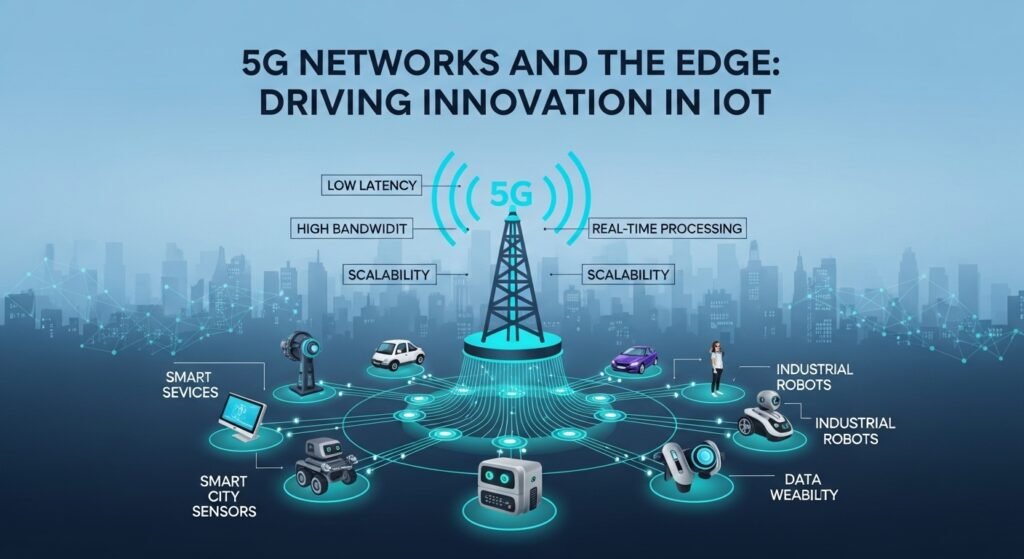
 Explore how 5G Networks and the Edge are driving innovation in IoT withreal-world use cases, benefits, and future trends. Imagine a surgeon in London guiding a robotic arm in Mumbai — in real time, with zero noticeable delay. Or a self-driving car processing thousands of sensor signals every second without missing a beat. These scenarios are no longer science fiction. They are becoming reality because of one powerful combination: 5G Networks and the Edge: Driving Innovation in IoT. We are living through a connectivity revolution. The Internet of Things (IoT) has alreadyconnected billions of devices — from industrial sensors to smart home gadgets. But legacy networks were never designed for this scale or speed. Enter 5G and edge computing: a duo that is reshaping how devices communicate, how data is processed, and how businesses create value. This article dives deep into how 5G and edge computing work together, why this combination matters for IoT, and what it means for industries, developers, and everyday users around the world. Table of Contents 1. What Are 5G Networks? A Quick Overview 2. Understanding Edge Computing and Its Role in IoT 3. How 5G and Edge Computing Work Together 4. Key Benefits of 5G + Edge for IoT Innovation 5. Real-World Applications Across Industries 1. What Are 5G Networks? A Quick Overview 5G is the fifth generation of wireless technology. It is not simply a faster version of 4G — it is a completely new architecture designed from the ground up to handle a world saturated with connected devices. The three pillars of 5G: • Enhanced Mobile Broadband (eMBB) — speeds up to 20 Gbps for data-heavy applications like 4K/8K streaming and AR/VR. • Ultra-Reliable Low-Latency Communication (URLLC) — latency as low as 1 millisecond, critical for autonomous vehicles and remote surgery. • Massive Machine-Type Communications (mMTC) — supports up to 1 million devices per square kilometre, perfect for dense IoT deployments. According to the GSMA, there will be over 1.7 billion 5G connections globally by the end of 2025, representing nearly 20% of all mobile connections. This explosive growth is creating the backbone that IoT needs to truly scale. 2. Understanding Edge Computing and Its Role in IoT Traditional cloud computing processes data in centralised data centres — often thousands of kilometres from where that data is generated. For many IoT use cases, this distance introduces unacceptable delays. Edge computing solves this by moving processing power closer to the data source — to the ‘edge’ of the network. This could be a local server in a factory, a base station on a street corner,or a mini data centre inside a retail store. Why edge computing matters for IoT: • Reduces round-trip data travel, cutting latency from hundreds of milliseconds to under 5ms. • Reduces bandwidth costs by processing and filtering data locally before sending to the cloud. • Improves data privacy — sensitive data never leaves the local environment. • Enables offline functionality — devices keep working even if the cloud connection drops. • Supports AI inference at the device level for real-time decision-making. A 2024 IDC report found that more than 50% of new enterprise IT infrastructure will be deployed at the edge by 2026 — a staggering shift driven largely by the growth of IoT applications. Key Benefits of 5G + Edge for IoT Innovation Real-World Applications Across Industries â–  Healthcare • Remote patient monitoring via 5G-connected wearables sends vitals to doctors in real time. • Robotic-assisted surgery uses 5G’s ultra-low latency to eliminate dangerous lags. • Edge AI analyses medical imaging on-site, speeding up diagnosis significantly. • Example: Ericsson and King’s College London demonstrated remote robotic surgery over a live 5G network. â–  Manufacturing & Industry 4.0 • Connected machines on the factory floor communicate via 5G to coordinate tasks. • Predictive maintenance sensors detect equipment anomalies before failures occur. • AR-assisted maintenance guides workers using real-time edge-processed visual overlays. • Example: Volkswagen deployed 5G-connected IoT in its smart factory in Wolfsburg, Germany. â–  Autonomous Vehicles • Self-driving cars process sensor data at the edge in under 10ms to make split-second decisions. • Vehicle-to-everything (V2X) communication uses 5G to share road conditions instantly. • Traffic management systems process data from thousands of vehicles simultaneously. â– â–  Smart Cities • 5G-connected streetlights, waste management, and water systems create responsive urban infrastructure. • Real-time traffic management reduces congestion by dynamically adjusting signals. • Edge computing processes surveillance data locally, reducing privacy risks. • Example: Singapore’s Smart Nation initiative uses 5G IoT for city-wide monitoring and efficiency. â– Agriculture • Precision agriculture sensors monitor soil moisture, crop health, and weather in real time.• Drones equipped with 5G transmit crop analysis data directly to edge servers on farms. • Automated irrigation systems respond instantly to sensor data without cloud delays. 10. Internal & External Link Strategy 5 Internal Link Ideas: â–  What Is Edge Computing? A Beginner’s Guide → /edge-computing-guide â–  IoT Security Best Practices for 2025 → /iot-security-best-practices â–  How 5G Is Transforming Smart Manufacturing → /5g-smart-manufacturing 3 External Authority Sources: â–  GSMA Intelligence — 5G Connections Forecast: https://www.gsma.com/intelligence â–  ETSI MEC Standards — Multi-Access Edge Computing: https://www.etsi.org/technologies/multi-access-edge-computing â–  McKinsey Global Institute — IoT Value Report: https://www.mckinsey.com/industries/internet-of-thing â–  References & Authority Sources [•] GSMA Intelligence. (2024). The Mobile Economy 2024. https://www.gsma.com/intelligence [•] IDC. (2024). Worldwide Edge Spending Guide. https://www.idc.com [•] Statista. (2024). Number of IoT Connected Devices Worldwide 2019–2030. https://www.statista.com [•] ETSI. (2024). Multi-Access Edge Computing Standards. https://www.etsi.org/mec [•] McKinsey Global Institute. (2023). The Internet of Things: Catching Up to an Accelerating Opportunity. [•] Ericsson. (2024). Ericsson Mobility Report June 2024. https://www.ericsson.com/mobility-report

5G Networks and the Edge: Driving Innovation in IoT Read More »
The Gig Economy and Tech: Future of Freelance Work

The Gig Economy and Tech: Future of Freelance Work in 2026

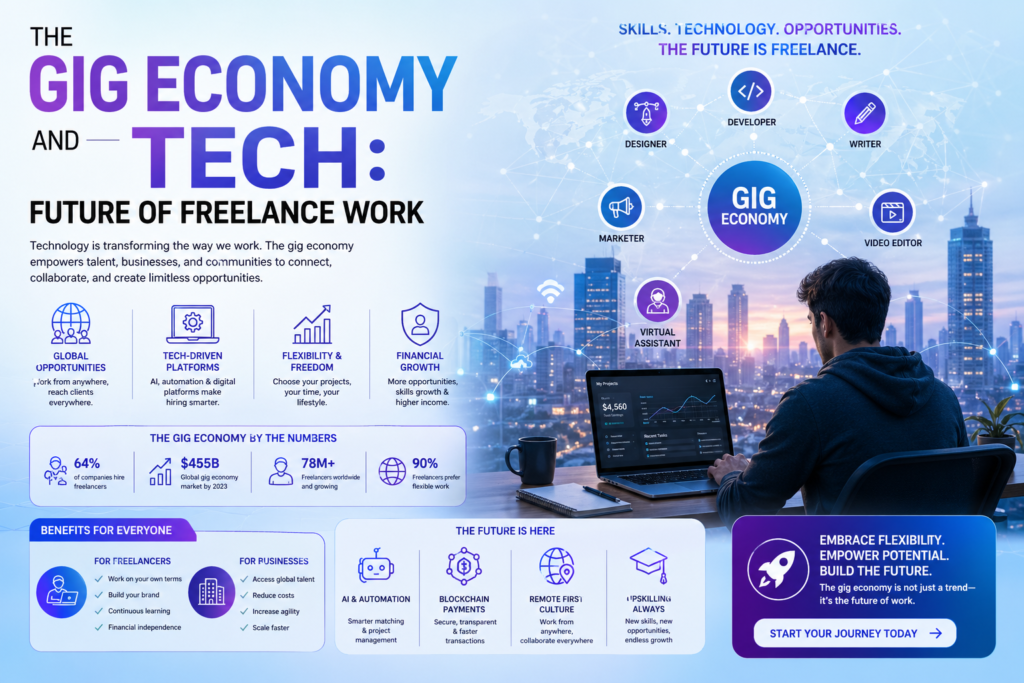
Table of Contents 1. Introduction — The New World of Work 2. What Is the Gig Economy? A Clear Definition 3. How Technology Powers the Gig Economy 4. Top Gig Economy Platforms Driven by Tech 5. Key Statistics: The Gig Economy by the Numbers 6. Benefits of the Gig Economy and Tech Convergence 7. Challenges Facing Gig Workers in the Digital Age 8. The Future of Work: Where the Gig Economy Is Heading 9. Expert Tips for Thriving as a Gig Worker 10. Common Mistakes Gig Workers Make (and How to Avoid Them) 11. FAQ — People Also Ask 12. Conclusion & Call to Action 13. Media, Internal & External Link Recommendations 1. Introduction — The New World of Work Picture this: you wake up, grab your phone, and decide what kind of work you want to do today. No manager checking in, no fixed schedule, no rush-hour traffic. For more than 1.5 billion people worldwide, this isn’t a fantasy—it’s daily life. The rise of the gig economy, powered by rapid technological advancement, is transforming how people earn a living. From freelance developers and graphic designers to delivery drivers and online tutors, millions now rely on digital platforms to find work and get paid. Technology sits at the center of it all—mobile apps connect workers with clients, AI tools match skills to tasks, and digital payment systems ensure quick, seamless transactions across borders. What started as a flexible side hustle has grown into a massive global market worth hundreds of billions of dollars—and it’s still expanding. This shift is not just changing jobs; it’s redefining the very concept of employment. In this article, we’ll explore how technology and the gig economy are shaping each other, what this means for both workers and businesses, and how you can take advantage of the opportunities while avoiding common pitfalls. By the end, you’ll have a clear understanding of where this trend is heading—and how to stay ahead of it. 2. What Is the Gig Economy? A Clear Definition The term gig economy refers to a labor market where short-term contracts and freelance work replace traditional permanent employment. Instead of a 9-to-5 job with a single employer, workers take on multiple assignments — or ‘gigs’ — often through digital platforms. The gig economy covers three broad categories: Category Description Example On-demand services Immediate local task fulfillment TaskRabbit, DoorDash, Postmates Platform-based Work sourced through apps or websites Uber, Fiverr, Upwork Freelance / Contract Independent professional services Copywriting, Web Dev, Design 3. How Technology Powers the Gig Economy 3.1 Mobile Apps and On-Demand Platforms The smartphone revolution made gig work accessible to anyone, anywhere. Mobile apps like Uber, Lyft,Instacart and Fiverr allow workers to sign up, get verified, and start earning within hours. Real-time GPS, pushnotifications, and in-app communication make the logistics of on-demand work seamless for both workers andclients. 3.2 Artificial Intelligence and Smart Matching Artificial intelligence works quietly behind the scenes of most major gig platforms. It processes data such as user profiles, past ratings, location, and availability to connect workers with suitable opportunities. This intelligent system helps clients find the right talent faster, enables workers to access more relevant jobs, and improves the platform’s overall efficiency. â–  Personalized job recommendations based on skills and historyâ–  Dynamic pricing models (surge pricing) that respond to real-time demandâ–  Fraud detection and identity verification for platform safetyâ–  Customer review systems that build digital reputation and trust 3.3 Cloud Computing and Remote Collaboration Cloud-based platforms such as Google Workspace, Notion, Slack, Zoom, and GitHub make it possible for freelancers to work seamlessly with clients from anywhere in the world. These tools remove the need for physical presence, enabling real-time communication, file sharing, and project management across different time zones. At the same time, cloud storage keeps important documents, project files, and deliverables securely stored, easy to access, and well-organized at all times. 3.4 Digital Payments and Financial Technology Receiving payments was once one of the biggest challenges for freelancers, often involving delays, high fees, and complicated processes. Today, financial technology has made it much smoother. Services like PayPal, Stripe, and Wise, along with cryptocurrency wallets, enable fast and seamless transactions across borders. In addition, many platforms now include built-in features such as escrow protection, automated invoicing, and tax management tools, making it much easier for freelancers to handle their finances efficiently. 3.5 Blockchain and Smart Contracts New advances in blockchain are beginning to change how trust works in the gig economy. With smart contracts, payments can be triggered automatically once agreed conditions are met and recorded on the blockchain. This reduces reliance on middlemen, minimizes disputes, and creates a more transparent and reliable payment system for freelancers across the globe. 4 . Top Gig Economy Platforms Driven by Tech 5. Key Statistics: The Gig Economy by the Numbers Numbers tell the real story of how massive and fast-moving the gig economy and tech convergence truly is 6. Benefits of the Gig Economy and Tech Convergence The marriage of the gig economy and tech creates value for workers, businesses, and entire economies. Here is a balanced look at the key advantages: For Workers ✔ Flexibility: Work when, where, and how much you want. Studies show flexibility is the #1 reason workers choose gig roles. ✔ Global clients: Tech platforms remove geographic barriers — a developer in Pakistan can easily serve clients in the United States. ✔ Income diversification: Workers can combine multiple gigs to build a stable, diverse income stream. ✔ Skill monetization: Niche skills that were hard to market locally are now globally sellable. ✔ Low entry barriers: Starting is fast — create a profile, list your skills, and begin earning within days. For Businesses ✔ Cost efficiency: Hire project-based talent instead of full-time employees, reducing overhead significantly. ✔ Speed: Access vetted, skilled professionals within hours rather than weeks. ✔ Scalability: Scale your workforce up or down based on project demand without HR complexity. ✔ Innovation: Fresh external perspectives from gig workers often inject new ideas into

The Gig Economy and Tech: Future of Freelance Work in 2026 Read More »