
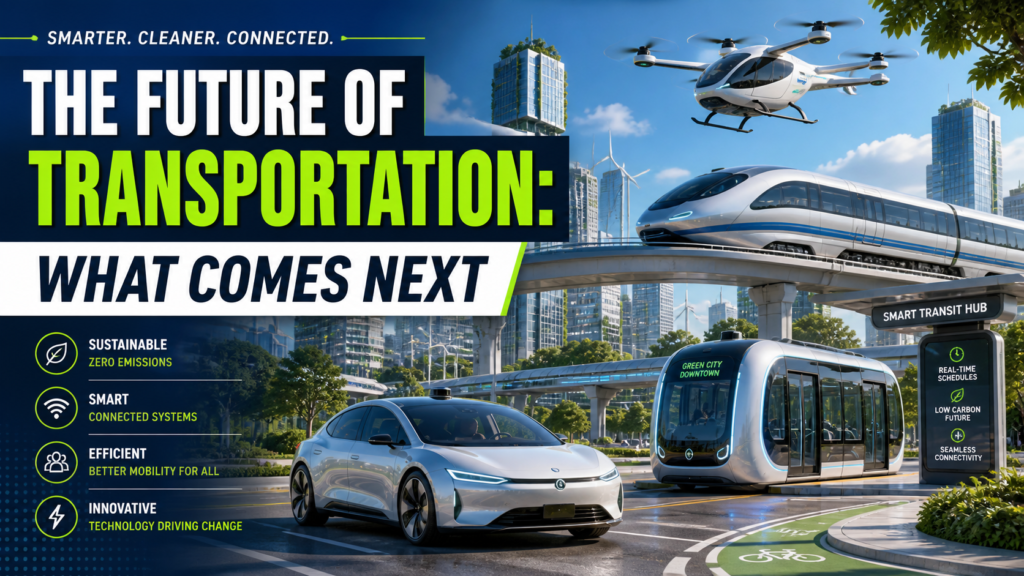
Explore the future of transportation — from self-driving cars and flying taxis to hyperloops and green energy vehicles. Discover what’s coming next in 2025 and beyond.
TABLE OF CONTENTS
1. Introduction
2. Why the Future of Transportation Matters
■ The global transport crisis
■ Environmental and economic stakes
3. Self-Driving Cars and Autonomous Vehicles
■ How autonomous vehicles work
■ Real-world examples today
4. Electric Vehicles: Powering Tomorrow’s Roads
■ EV market growth statistics
■ Charging infrastructure challenges
5. Hyperloop: The 700 mph Dream
■ How hyperloop technology works
■ Current hyperloop projects worldwide
6. Urban Air Mobility and Flying Taxis
■ eVTOL technology explained
■ Companies leading the skies
7. Smart Cities and Connected Transportation
8. Sustainable Transportation and Green Mobility
9. Mobility as a Service (MaaS): The Subscription Era
10. Expert Tips: How to Prepare for the Transport Revolution
11. Common Mistakes People Make About Transport Futures
12. FAQ – People Also Ask
13. Media, Internal Links & Authority Sources
14. Conclusion + Call to Action
1. Introduction
Imagine opening your front door, tapping your phone, and watching a flying taxi arrive just a few minutes later. You step inside, lift above the crowded streets, and reach the other side of the city without sitting in traffic for even a second. A few years ago, this sounded like something from a science-fiction movie. Today, it feels much closer to reality.
Transportation is changing faster than many people realise. The way we travel affects almost every part of modern life — the quality of the air we breathe, how much time we lose in traffic, how easily goods reach our homes, how cities grow, and how much carbon we release into the atmosphere. From electric vehicles and self-driving cars to high-speed rail, delivery drones, and smart traffic systems, a new mobility revolution is already underway.
This transformation is being powered by major advances in artificial intelligence, battery storage, clean energy, aerospace design, and digital infrastructure. Together, these technologies are creating a future where transportation could become cleaner, faster, safer, and more connected than ever before.
In this guide, we will explore the biggest trends shaping the future of transportation. You will learn how new technologies are changing the movement of people and goods, what real-world examples are already emerging, and what these changes could mean for everyday life, businesses, cities, and the global economy. Whether you are a student, investor, city planner, technology enthusiast, or simply a curious reader, this article will help you understand what is coming next — and why it matters.
2. Why the Future of Transportation Matters
Transportation keeps the modern world moving. From the food we buy at supermarkets to the daily commute, online deliveries, emergency services, and global trade, almost everything depends on reliable transport networks. But the systems we use today are facing growing strain.
2.1 The Global Transport Challenge
Around the world, transportation is becoming more expensive, crowded, and environmentally damaging. Traffic jams waste billions of hours every year. Cars, trucks, ships, and planes continue to produce a large share of global emissions. Cities are becoming more crowded, placing even more pressure on roads, railways, and public transit. At the same time, road accidents remain one of the biggest causes of preventable deaths worldwide.
Recent data shows how serious the problem has become:
Traffic congestion costs the U.S. economy tens of billions of dollars every year.
The transport sector produces nearly one-quarter of global carbon dioxide emissions.
By 2050, most of the world’s population is expected to live in urban areas, increasing the demand for faster and smarter mobility.
Road accidents claim more than a million lives globally each year.
These facts point to one major conclusion: the traditional transportation model is no longer enough. It is not clean enough, safe enough, or efficient enough for the future. The positive side is that change is already happening. Governments, technology companies, engineers, and entrepreneurs are now working on new solutions that could make transportation safer, greener, and far more intelligent.
2.2 Environmental and Economic Stakes
Decarbonising transport is not optional if the world is to meet its climate targets. The InternationalThe
Energy Agency estimates that electric vehicles, cleaner fuels, and smarter logistics must together
eliminate at least 50% of transport emissions by 2030 to stay on a net-zero pathway. At the same
time, smart mobility solutions could unlock trillions of dollars in economic value through saved
commute time, lower fuel costs, and reduced infrastructure spending
3. Self-Driving Cars and Autonomous Vehicles
Autonomous vehicles are one of the most important parts of the future transportation conversation. The idea is simple but powerful: if vehicles can drive themselves safely, they could reduce human mistakes, improve traffic flow, lower fuel waste, and make travel more efficient.
3.1 How Autonomous Vehicles Work
Self-driving vehicles use a combination of advanced hardware and intelligent software to understand the road around them. Instead of relying on a human driver’s eyes and reactions, these systems collect information from multiple sources simultaneously.
LiDAR helps the vehicle build a detailed 3D picture of its surroundings. Radar detects nearby objects and measures their speed, even in rain, fog, or low light. High-resolution cameras identify road signs, lane markings, traffic signals, pedestrians, and other vehicles. Artificial intelligence then studies all this information in real time and decides when to brake, turn, slow down, or change lanes. Many autonomous vehicles also use high-definition maps, which help them know their exact position on the road with impressive accuracy.
Automation is usually measured in levels. SAE International describes these levels from Level 0, where the human does everything, to Level 5, where the vehicle can drive completely on its own in every situation. At the moment, most systems available to consumers are still in the middle range. They can assist with steering, braking, acceleration, and some driving tasks, but they still need a human driver to stay alert and take control when required.
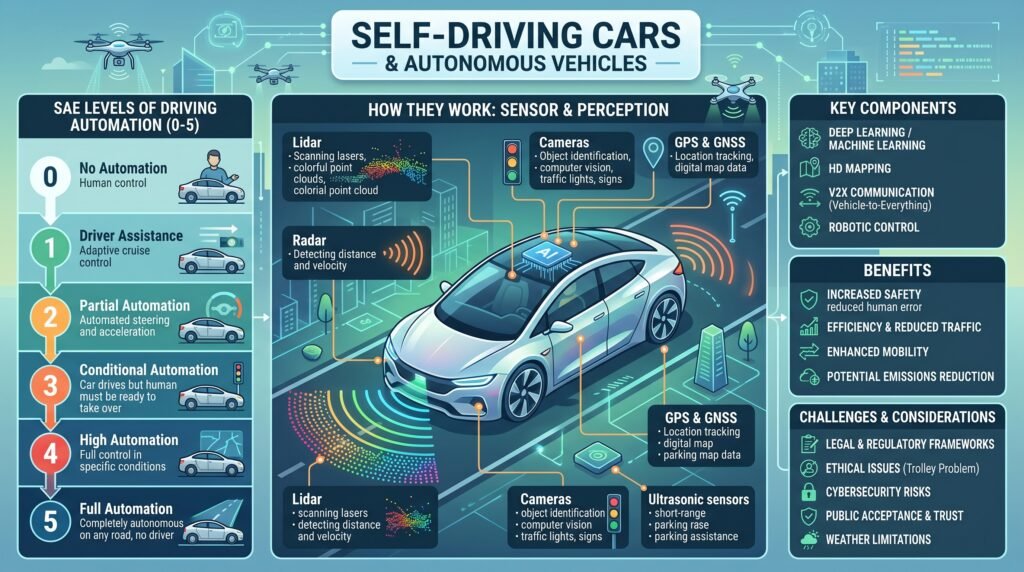
Self-Driving Cars and Autonomous Vehicles
■ INTERNAL LINK IDEAS
| ANCHOR TEXT / PAGE | Description |
|---|---|
| EV Buying Guide 2025 | Link from ‘electric vehicles’ sections — drives readers to a related conversion-focused page |
| Best Smart City Apps | Link from MaaS section — complements the subscription mobility discussion. |
| How Autonomous Vehicles Work | http://Detailed explainer page — link from the AV overview paragraph. |
| Sustainable Travel Tips | Evergreen content — link from the green mobility section. |
| Transportation Technology Trends | Category/hub page — link from the introduction as a related resource. |
■ EXTERNAL AUTHORITY SOURCES
| Organisation | Domain | Usage |
|---|---|---|
| BloombergNEF | about.bnef.com | Electric Vehicle Outlook — battery cost curves and market forecasts |
| World Health Organisation (WHO) | who. in | Road safety statistics — 1.35 million annual road fatalities. |
| International Energy Agency (IEA) | iea.org | Global EV Outlook 2024 — used for EV statistics and emission data. |