
Imagine a surgeon in London guiding a robotic arm in Mumbai — in real time, with zero noticeable delay. Or a self-driving car processing thousands of sensor signals every second without missing a beat. These scenarios are no longer science fiction. They are becoming reality because of one powerful combination: 5G Networks and the Edge: Driving Innovation in IoT. We are living through a connectivity revolution. The Internet of Things (IoT) has alreadyconnected billions of devices — from industrial sensors to smart home gadgets. But legacy networks were never designed for this scale or speed. Enter 5G and edge computing: a duo that is reshaping how devices communicate, how data is processed, and how businesses create value. This article dives deep into how 5G and edge computing work together, why this combination matters for IoT, and what it means for industries, developers, and everyday users around the world.
1. What Are 5G Networks? A Quick Overview
2. Understanding Edge Computing and Its Role in IoT
3. How 5G and Edge Computing Work Together
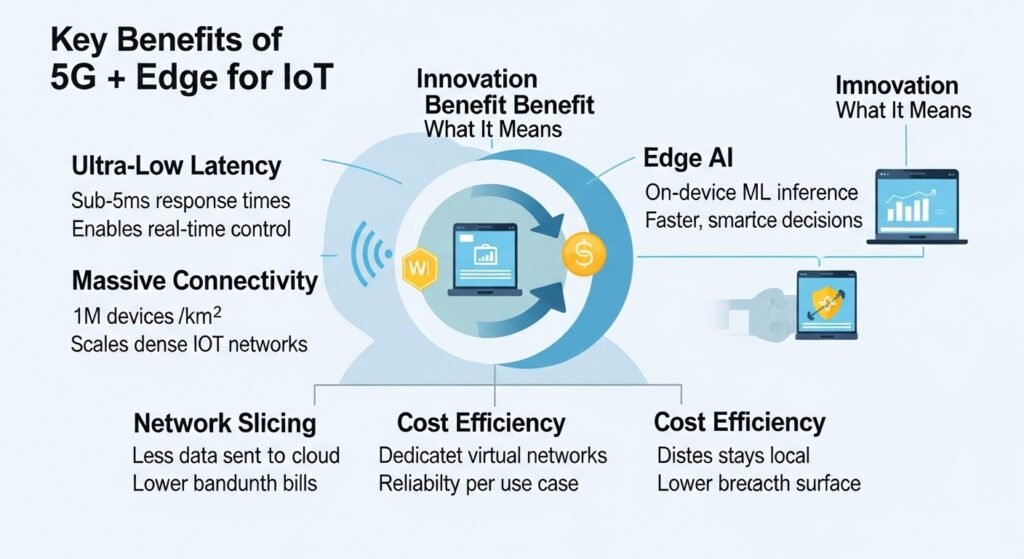
4. Key Benefits of 5G + Edge for IoT Innovation
5. Real-World Applications Across Industries
5G is the fifth generation of wireless technology. It is not simply a faster version of 4G — it is a
completely new architecture designed from the ground up to handle a world saturated with connected devices.
The three pillars of 5G:
• Enhanced Mobile Broadband (eMBB) —
speeds up to 20 Gbps for data-heavy applications like 4K/8K streaming and AR/VR.
• Ultra-Reliable Low-Latency Communication (URLLC) —
latency as low as 1 millisecond, critical for autonomous vehicles and remote surgery.
• Massive Machine-Type Communications (mMTC) —
supports up to 1 million devices per square kilometre, perfect for dense IoT deployments.
According to the GSMA, there will be over 1.7 billion 5G connections globally by the end of 2025,
representing nearly 20% of all mobile connections. This explosive growth is creating the backbone that IoT needs to truly scale.
2. Understanding Edge Computing and Its Role in IoT
Traditional cloud computing processes data in centralised data centres — often thousands of kilometres from where that data is generated. For many IoT use cases, this distance introduces unacceptable delays. Edge computing solves this by moving processing power closer to the data source — to the ‘edge’ of the network. This could be a local server in a factory, a base station on a street corner,or a mini data centre inside a retail store.
Why edge computing matters for IoT:
• Reduces round-trip data travel, cutting latency from hundreds of milliseconds to under 5ms.
• Reduces bandwidth costs by processing and filtering data locally before sending to the cloud.
• Improves data privacy — sensitive data never leaves the local environment.
• Enables offline functionality — devices keep working even if the cloud connection drops.
• Supports AI inference at the device level for real-time decision-making.
A 2024 IDC report found that more than 50% of new enterprise IT infrastructure will be deployed
at the edge by 2026 — a staggering shift driven largely by the growth of IoT applications.
Key Benefits of 5G + Edge for IoT Innovation
Real-World Applications Across Industries
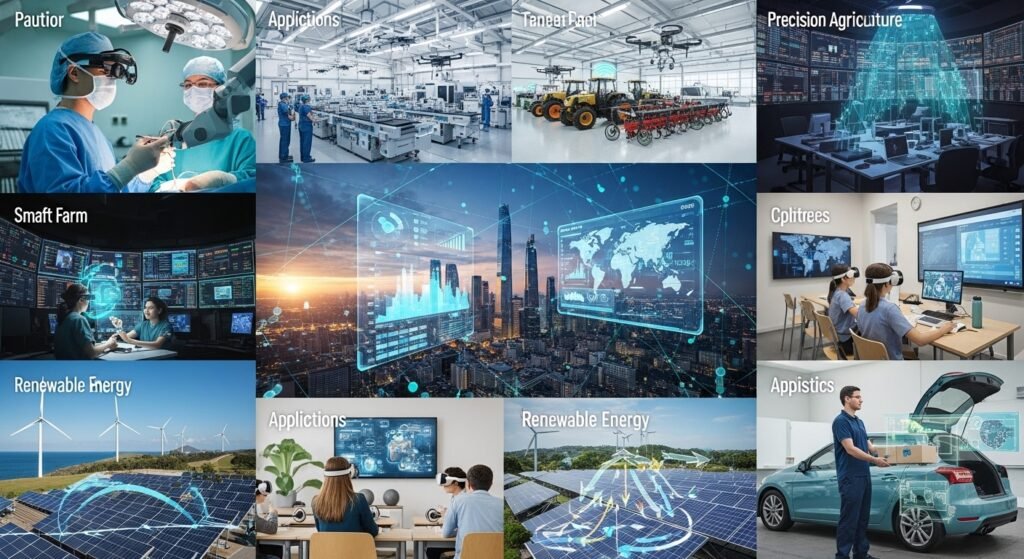
■ Healthcare
• Remote patient monitoring via 5G-connected wearables sends vitals to doctors in real time.
• Robotic-assisted surgery uses 5G’s ultra-low latency to eliminate dangerous lags.
• Edge AI analyses medical imaging on-site, speeding up diagnosis significantly.
• Example: Ericsson and King’s College London demonstrated remote robotic surgery over a live 5G network.
■ Manufacturing & Industry 4.0
• Connected machines on the factory floor communicate via 5G to coordinate tasks.
• Predictive maintenance sensors detect equipment anomalies before failures occur.
• AR-assisted maintenance guides workers using real-time edge-processed visual overlays.
• Example: Volkswagen deployed 5G-connected IoT in its smart factory in Wolfsburg, Germany.
■ Autonomous Vehicles
• Self-driving cars process sensor data at the edge in under 10ms to make split-second decisions.
• Vehicle-to-everything (V2X) communication uses 5G to share road conditions instantly.
• Traffic management systems process data from thousands of vehicles simultaneously.
■■ Smart Cities
• 5G-connected streetlights, waste management, and water systems create responsive urban infrastructure.
• Real-time traffic management reduces congestion by dynamically adjusting signals.
• Edge computing processes surveillance data locally, reducing privacy risks.
• Example: Singapore’s Smart Nation initiative uses 5G IoT for city-wide monitoring and efficiency.
■Agriculture
• Precision agriculture sensors monitor soil moisture, crop health, and weather in real time.• Drones equipped with 5G transmit crop analysis data directly to edge servers on farms.
• Automated irrigation systems respond instantly to sensor data without cloud delays.
5 Internal Link Ideas:
■ What Is Edge Computing? A Beginner’s Guide → /edge-computing-guide
■ IoT Security Best Practices for 2025 → /iot-security-best-practices
■ How 5G Is Transforming Smart Manufacturing → /5g-smart-manufacturing
■ GSMA Intelligence — 5G Connections Forecast: https://www.gsma.com/intelligence
■ ETSI MEC Standards — Multi-Access Edge Computing:
https://www.etsi.org/technologies/multi-access-edge-computing
■ McKinsey Global Institute — IoT Value Report:
https://www.mckinsey.com/industries/internet-of-thing
[•] GSMA Intelligence. (2024). The Mobile Economy 2024. https://www.gsma.com/intelligence
[•] IDC. (2024). Worldwide Edge Spending Guide. https://www.idc.com
[•] Statista. (2024). Number of IoT Connected Devices Worldwide 2019–2030. https://www.statista.com
[•] ETSI. (2024). Multi-Access Edge Computing Standards. https://www.etsi.org/mec
[•] Ericsson. (2024). Ericsson Mobility Report June 2024. https://www.ericsson.com/mobility-report