
Machine Learning: The Ultimate Beginner-to-Pro Guide
Table of Contents
1. Introduction: Why Machine Learning Matters Right Now
2. What Is Machine Learning? A Clear Definition
3. How Machine Learning Works — Step by Step
4. Types of Machine Learning Explained
5. Real-World Machine Learning Applications
6. Top Machine Learning Tools & Frameworks
7. Expert Tips for Getting Started
8. Common Mistakes to Avoid
9. Frequently Asked Questions (People Also Ask)
10. Internal & External Resources
11. Conclusion & Call to Action
1. Introduction: Why Machine Learning Matters Right Now
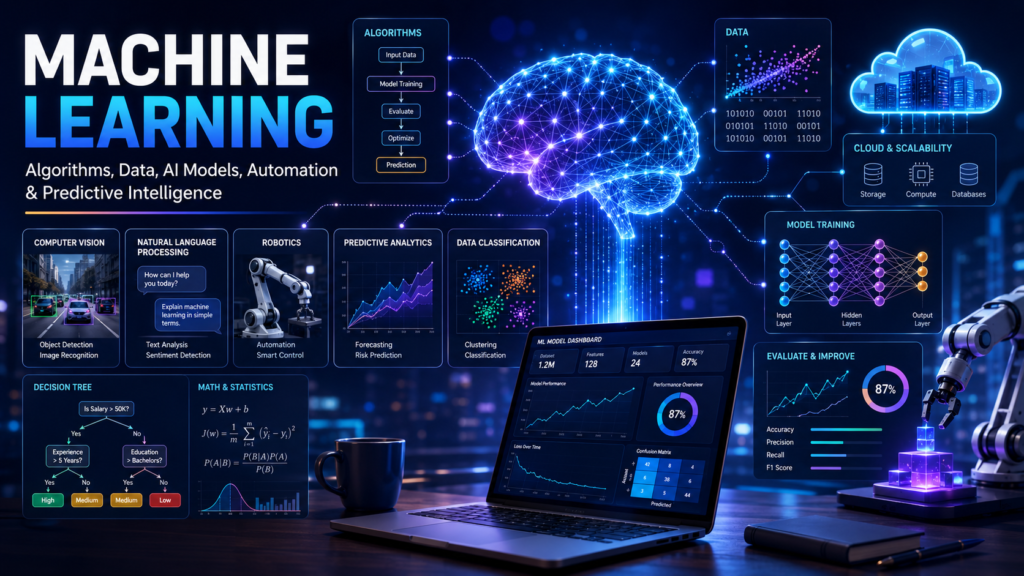
Machine Learning: The Ultimate Beginner-to-Pro Guide
2. What Is Machine Learning? A Clear Definition
Machine learning is a branch of artificial intelligence (AI) that enables computers to learn from data and
improve their performance over time — without being explicitly programmed for each task. Instead of
following hard-coded rules, a machine learning model identifies patterns in data and uses those patterns to
make predictions or decisions.
Arthur Samuel, the pioneer who coined the term in 1959, defined it as: “the field of study that gives
computers the ability to learn without being explicitly programmed.” That definition still holds perfectly true
today.
Key Concepts You Must Know
• Algorithm: A set of rules or instructions the model uses to learn.
• Training Data: The dataset fed to the model so it can learn patterns.
• Model: The output of training — a mathematical function that makes predictions.
• Features: The input variables the model uses (e.g., age, income, pixels).
• Labels: The output variable the model tries to predict (e.g., spam / not spam)
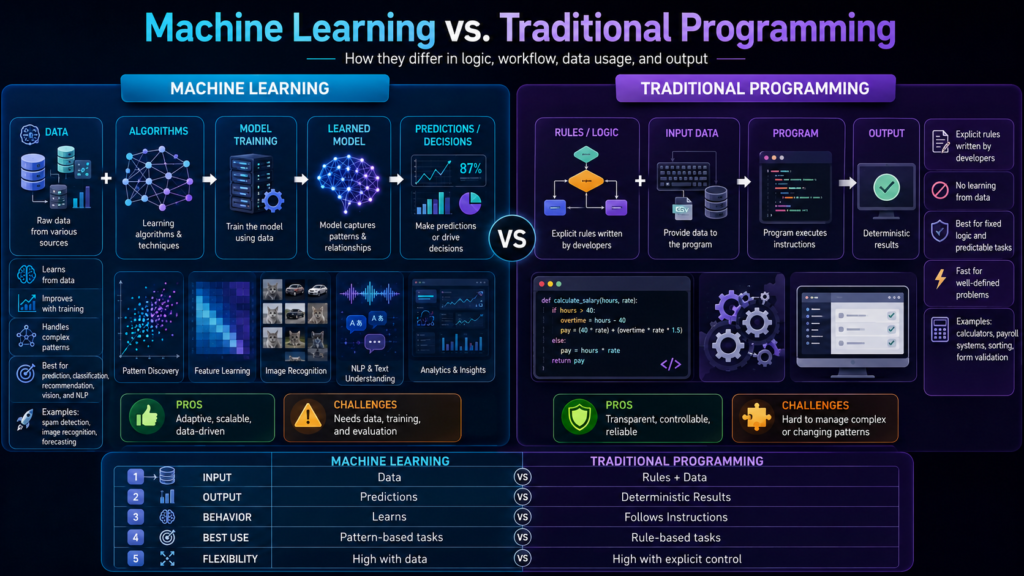
| Traditional Programming | Machine Learning |
|---|---|
| Rules are written by humans | Rules are learned from data |
| Static — doesn’t improve over time | Dynamic — improves with more data |
| Breaks with edge cases | Adapts to new patterns |
| Best for predictable tasks | Best for complex, pattern-heavy tasks |
How Machine Learning Works — Step by Step
Understanding how machine learning works does not require a math degree. Here is a straightforward
breakdown of the process from raw data to working model:
- Collect Data: Gather relevant, high-quality data. More diverse data usually means a better model.
- Prepare & Clean Data: Remove duplicates, handle missing values, and normalize data so the model
can process it. - Choose an Algorithm: Select the right machine learning algorithm based on your problem type
(classification, regression, clustering, etc.). - Train the Model: Feed the training data into the algorithm. The model adjusts its internal parameters
to minimize errors. - Evaluate the Model: Test the model on unseen data. Use metrics like accuracy, precision, recall,
and F1 score. - Tune & Optimize: Adjust hyperparameters, add more data, or try different algorithms to improve
performance. - Deploy the Model: Integrate the trained model into a real-world application or API endpoint.
- Monitor & Retrain: Track performance over time and retrain with new data to maintain accuracy
4. Types of Machine Learning Explained
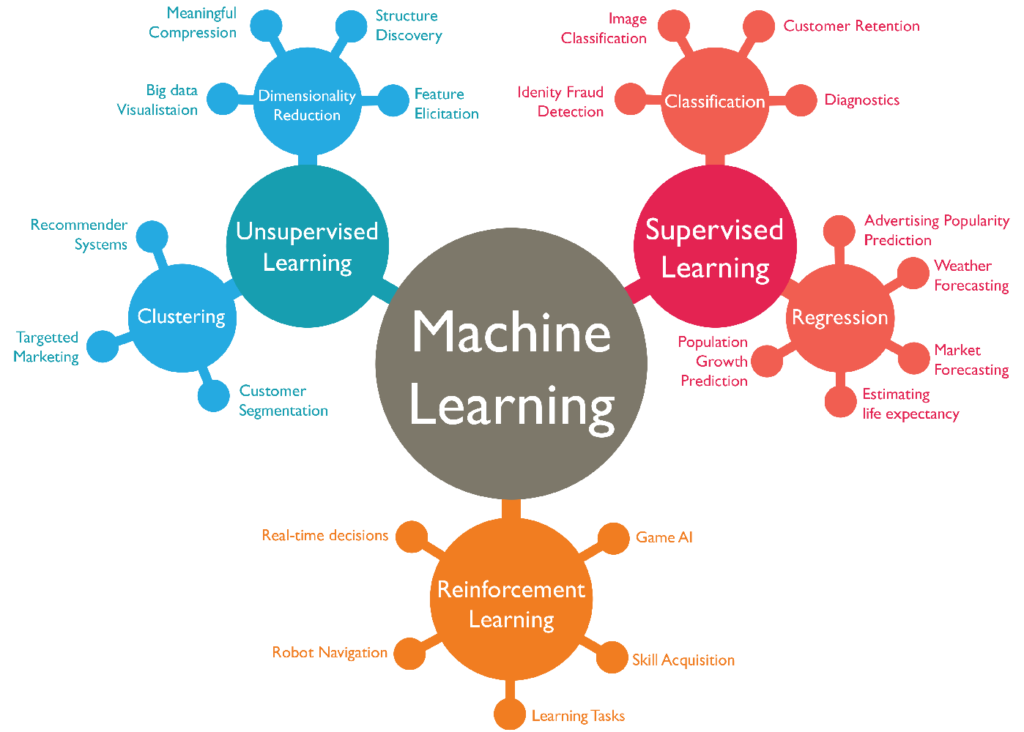
There are four primary types of machine learning, each suited to different problems and data scenarios.
Knowing which type to use is the first step toward building effective ML models.
Supervised Learning
The model is trained on labeled data — both inputs and correct outputs are provided. It learns to map inputs
to outputs.
Examples: Email spam detection, house price prediction, image classification.
Key Algorithms: Linear Regression, Logistic Regression, Decision Trees, Support Vector Machines (SVM),
Random Forest.
Unsupervised Learning
The model works with unlabeled data and finds hidden patterns or groupings on its own.
Examples: Customer segmentation, anomaly detection, and topic modeling.
Key Algorithms: K-Means Clustering, DBSCAN, Principal Component Analysis (PCA), and Autoencoders.
Semi-Supervised Learning
Uses a small amount of labeled data combined with a large amount of unlabeled data. Ideal when labeling
is expensive or time-consuming.
Examples: Medical image analysis, speech recognition.
Key Algorithms: Self-training, Label Propagation, Generative Adversarial Networks (GANs).
Reinforcement Learning
An agent learns by interacting with an environment, receiving rewards for correct actions and penalties for incorrect actions
wrong ones.
Examples: Game-playing AI (AlphaGo), robotics, and autonomous vehicles.
Key Algorithms: Q-Learning, Deep Q-Network (DQN), Proximal Policy Optimization (PPO).
5. Real-World Machine Learning Applications
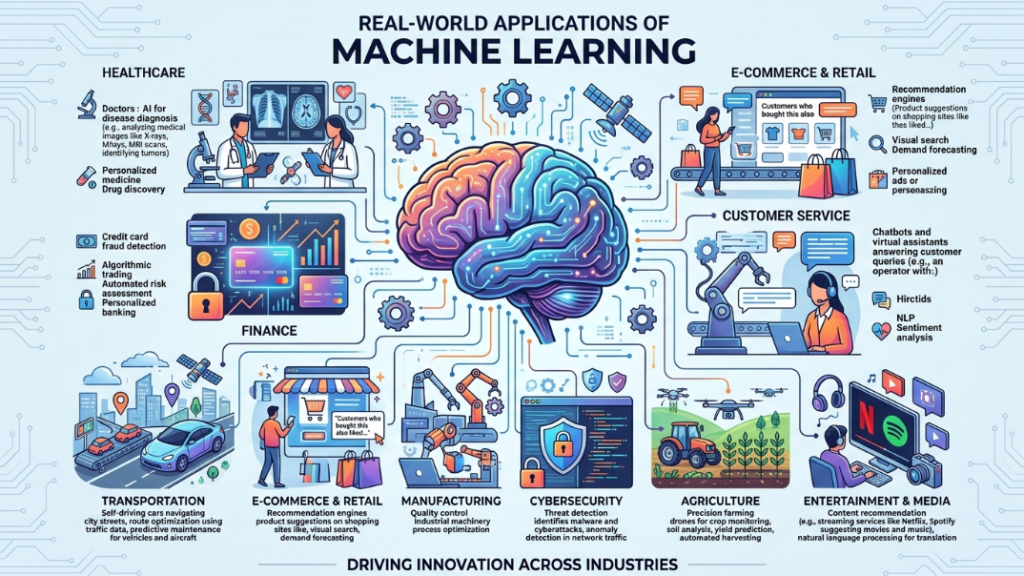
Machine learning is not just a tech trend — it is actively transforming every major industry. Here are the
Most impactful real-world applications of machine learning today:
Healthcare & Medical Technology
- AI-assisted medical imaging is helping doctors identify diseases such as cancer with significantly improved accuracy and faster analysis.
- Machine learning is accelerating drug research by shortening the time needed to discover and test potential treatments.
- Hospitals are using predictive analytics to reduce patient readmissions and create more personalized treatment strategies.
- Smart wearable devices can now monitor health conditions in real time using lightweight machine learning models built directly into the device.
Finance & Banking
- Financial institutions use machine learning systems to detect suspicious transactions instantly and reduce fraud-related losses.
- Automated trading platforms analyze market trends and data patterns to support investment decisions and portfolio management.
- Banks apply AI-based credit scoring systems to speed up loan approvals and assess financial risk more efficiently.
- Predictive customer analytics helps companies understand user behavior, reduce customer loss, and deliver personalized financial services.
Retail & E-Commerce
- Recommendation systems suggest products based on customer interests, browsing activity, and purchasing behavior.
- Retailers use dynamic pricing tools to adjust prices according to demand, stock availability, and market competition.
- Visual search technology allows shoppers to find products by uploading or scanning images instead of typing keywords.
- AI-powered forecasting helps businesses manage inventory, improve supply chain operations, and reduce product shortages or overstock situations.
Natural Language Processing (NLP)
• Real-time translation services (Google Translate, DeepL)
• Virtual assistants: Siri, Alexa, Google Assistant
• Sentiment analysis for brand monitoring
• AI writing assistants and content generation tools
Transportation & Logistics
• Self-driving vehicle perception and decision-making
• Route optimization for delivery fleets
• Predictive maintenance for aircraft engines
• Traffic flow prediction and smart city management
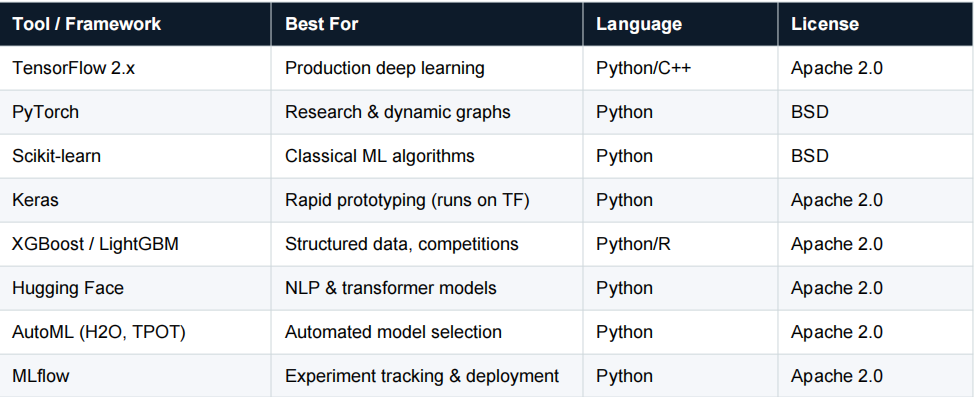
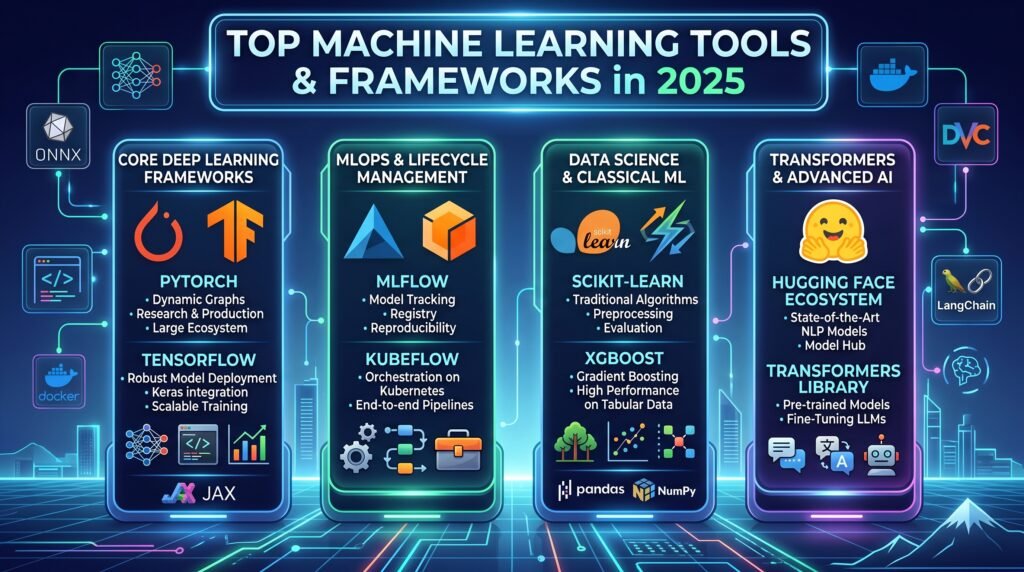
6. Top Machine Learning Tools & Frameworks in 2026
Choosing the right machine learning tools can make or break your project. Here are the most widely used
and trusted frameworks in the industry today:
7. Expert Tips for Getting Started with Machine Learning
✓ Master the Fundamentals First
Before jumping into deep learning or neural networks, build a solid foundation in statistics, linear algebra, and
Python programming. These are the three pillars every successful ML practitioner relies on daily.
✓ Start with Small, Clean Datasets
Beginners often try to tackle massive datasets too early. Start with well-known datasets like Iris, MNIST, or the
Titanic survival dataset. Small datasets let you experiment faster and understand results more clearly.
✓ Use Cross-Validation Religiously
Never evaluate your model on the same data it was trained on. Use k-fold cross-validation to get an honest
estimate of how your model will perform on real, unseen data. Overfitting is the #1 beginner mistake.
✓ Learn From Kaggle Competitions
Kaggle.com is the world’s largest data science community. Participating in competitions — even without
winning — exposes you to real problems, diverse datasets, and battle-tested techniques shared by experts in
public notebooks.
✓ Document Everything With MLflow
Track your experiments, parameters, metrics, and model versions from day one. Without proper tracking, you
will waste hours trying to recreate results that worked last week. MLflow is free, open-source, and integrates
with every major framework.
✓ Keep Up With Research via ArXiv & Papers With Code
Machine learning moves fast. Subscribe to ArXiv’s cs.LG section and follow paperswithcode.com to stay
current. Implementing one new paper per month will dramatically accelerate your growth as an ML
practitioner.
8. Common Machine Learning Mistakes to Avoid
Even experienced practitioners make these mistakes. Knowing them in advance will save you weeks of
debugging and frustration:
✗ 1. Data Leakage
Accidentally including future or target-related information in your training data. This gives you artificially
inflated accuracy that collapses in production. Always split your data before any preprocessing steps.
✗ 2. Ignoring Class Imbalance
Building a model on imbalanced data (e.g., 99% non-fraud, 1% fraud) without correction will result in a model
that predicts the majority class 100% of the time and appears 99% accurate — but is completely useless. Use
SMOTE, class weights, or resampling.
✗ 3. Overfitting
Your model memorizes the training data instead of learning generalizable patterns. Signs: near-perfect
training accuracy, poor validation accuracy. Fix: add dropout, regularization (L1/L2), reduce model complexity,
or collect more data.
✗ 4. Skipping Exploratory Data Analysis (EDA)
Jumping straight to modeling without understanding your data is a recipe for failure. Always visualize
distributions, check for outliers, and understand correlations before you write a single line of model code.
✗ 5. Using Accuracy as the Only Metric
Accuracy alone is misleading, especially on imbalanced datasets. Always report precision, recall, F1 score,
AUC-ROC, and confusion matrices for a complete picture of model performance.
9. Frequently Asked Questions About Machine Learning
These questions come directly from Google’s ‘People Also Ask’ section for machine learning-related
searches:
Q: What is machine learning and how does it work?
A: Machine learning is a subset of artificial intelligence that allows computers to learn from data without
being explicitly programmed. It works by feeding training data into an algorithm, which identifies patterns
and builds a model. That model is then used to make predictions or decisions on new, unseen data.
Q: What is the difference between machine learning and deep learning?
A: Machine learning is the broader field that includes all techniques where computers learn from data.
Deep learning is a specialized subset of machine learning that uses artificial neural networks with many
layers (hence ‘deep’) to process complex, unstructured data like images, audio, and text. All deep
learning is machine learning, but not all machine learning is deep learning.
Q: Is machine learning hard to learn?
A: Machine learning has a learning curve, but it is accessible to anyone willing to invest time. With free
resources like Coursera, fast.ai, and Kaggle, most beginners can build their first working ML model within
30–60 days. Python programming, basic statistics, and linear algebra are the recommended
prerequisites.
Q: What programming language is best for machine learning?
A: Python is overwhelmingly the most popular language for machine learning, thanks to its rich
ecosystem of libraries (TensorFlow, PyTorch, Scikit-learn, Pandas, NumPy). R is popular for statistical
analysis and data visualization. Julia is gaining traction for high-performance scientific computing. For
most learners and professionals, Python is the clear first choice.
Q: What are the best free resources to learn machine learning?
A: The top free resources include: (1) Andrew Ng’s Machine Learning Specialization on Coursera (free to
audit), (2) fast.ai’s Practical Deep Learning for Coders, (3) Google’s Machine Learning Crash Course, (4)
Kaggle’s free micro-courses, and (5) StatQuest with Josh Starmer on YouTube for statistical concepts
explained visually
10. Internal & External SEO Resources
Suggested Internal Links
→ /blog/what-is-artificial-intelligence → ‘What Is Artificial Intelligence? A Beginner’s Guide’
→ /blog/deep-learning-explained → ‘Deep Learning Explained: Neural Networks for Beginners’
→ /blog/python-for-data-science → ‘Python for Data Science: The Complete 2025 Roadmap.’
→ /blog/best-data-science-courses → ‘Top 10 Data Science Courses Online in 2025 (Free & Paid)’
→ /blog/machine-learning-projects → ’15 Beginner Machine Learning Projects to Build Your Portfolio
Authority External Sources
Google AI Blog — ai.googleblog.com (Official ML research & announcements)
ArXiv CS.LG — arxiv.org/list/cs.LG/recent (Peer-reviewed ML research papers)
MIT Technology Review — technologyreview.com (Expert analysis on AI & ML trends)
http://MIT Technology Review — technologyreview.com (Expert analysis on AI & ML trends)
11. Conclusion: Your Machine Learning Journey Starts Now
Machine learning is one of the most transformative technologies of the 21st century. From healthcare to
finance, retail to transportation, it is reshaping how every industry operates and creating enormous
opportunities for those who understand it.
In this guide, you have learned what machine learning is, how it works step by step, the four core types of
machine learning, real-world applications driving billions in value, the top tools and frameworks
professionals use, expert tips to accelerate your learning, and critical mistakes to avoid along the way.
The barrier to entry has never been lower. Free courses, open-source tools, and vibrant communities mean
that anyone — regardless of background — can learn machine learning and apply it to solve meaningful
problems.