The Rise of Remote Work: Complete Guide 2026
How Flexible Work Is Redefining Careers, Businesses, and the Global Economy
Remote work has rapidly shifted from a rare workplace benefit to a global standard. What once existed mainly in tech circles has now spread across industries, countries, and job roles. The turning point came during the COVID-19 pandemic, which accelerated workplace transformation at an unprecedented pace. Changes that might have taken a decade happened in just a year and a half.
Research from workplace experts such as Stanford economist Nicholas Bloom shows that remote work increased sharply during the pandemic and has stayed far above previous levels ever since. This is not a temporary trend. It represents a long-term structural shift in how work is done.
In this guide, we will break down everything you need to know: how remote work evolved, why it grew so fast, its benefits and challenges, and what the future may look like.
A Short History of Remote Work
Remote work did not begin with laptops or Wi-Fi. Its roots go much further back. In the 1970s, the idea of telecommuting was introduced as a way to move work to people instead of forcing people to travel to work. At the time, the concept sounded futuristic and was limited to only a few industries.
By the 1990s and early 2000s, the internet changed the possibilities. Email, file sharing, and early video calls made long-distance collaboration more practical. During the 2010s, startups and digital-first companies proved that distributed teams could perform successfully without a traditional office.
Then came 2020. The pandemic forced businesses worldwide to adopt remote work almost overnight. Many companies expected productivity to collapse, but in many cases, the opposite happened. Teams adapted, tools improved, and employees began to question whether the old office routine was truly necessary.
Key Statistics That Define the Trend
The numbers clearly show that remote work is not fading. A large share of knowledge workers now work remotely at least part-time. Remote job listings often attract far more applicants than traditional office roles. Most employees say they want at least some flexibility in where they work.
- Many knowledge workers now work remotely or in hybrid arrangements.
- Remote roles often receive stronger applicant interest.
- Employees save time and money by reducing commuting.
- Companies can reduce office costs and access wider talent pools.
- Productivity can improve when remote work is managed properly.
This data points to one clear conclusion: remote work has become a permanent part of the modern employment landscape.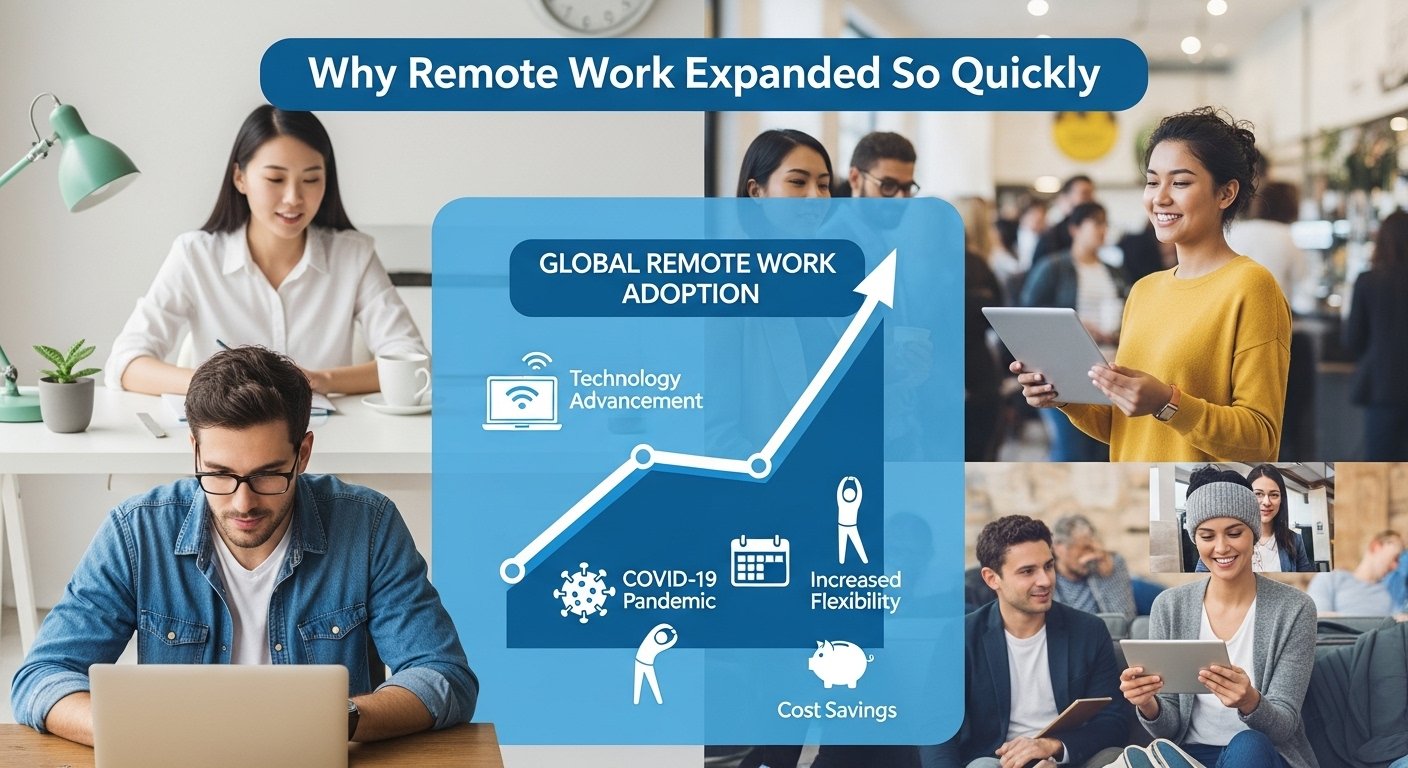
Why Remote Work Expanded So Quickly
1. The Pandemic Effect
COVID-19 removed hesitation almost instantly. Businesses that had resisted remote work for years suddenly had to make it work. The global experiment proved that many tasks could be completed effectively outside the office.
2. Technology Readiness
Cloud platforms, video calls, messaging apps, project management systems, and digital security tools were already mature enough to support remote teams. The technology was ready when the demand arrived.
3. Global Talent Access
Companies realized that they no longer had to hire only within commuting distance. Remote work allowed them to recruit skilled professionals from different cities, countries, and time zones.
4. Cost Reduction
Large offices are expensive. Remote and hybrid models help businesses reduce rent, utilities, maintenance, and other operational expenses.
5. Changing Worker Priorities
Employees increasingly value flexibility, autonomy, and balance. For many workers, the option to work remotely has become a major factor when choosing a job.
Benefits of Remote Work for Employees
Remote work gives employees more control over their time, environment, and daily routine. Removing the commute alone can return hundreds of hours per year. Those hours can be used for family, health, learning, rest, or focused work.
- Time savings: Less time spent in traffic or public transport.
- Lower expenses: Reduced spending on fuel, meals, clothing, and commuting.
- Better focus: Fewer office interruptions for many workers.
- Location freedom: More choice over where to live and work.
- Improved balance: Easier management of personal and professional responsibilities.
Benefits of Remote Work for Employers
Employers also gain major advantages from remote work. Businesses can reduce overhead, attract stronger candidates, improve retention, and build more flexible operations. For companies competing for specialized talent, remote hiring can be a strategic advantage.
- Reduced office and operational costs
- Access to a wider talent pool
- Higher employee satisfaction and retention
- Potential productivity gains in focused roles
- Better coverage across multiple time zones
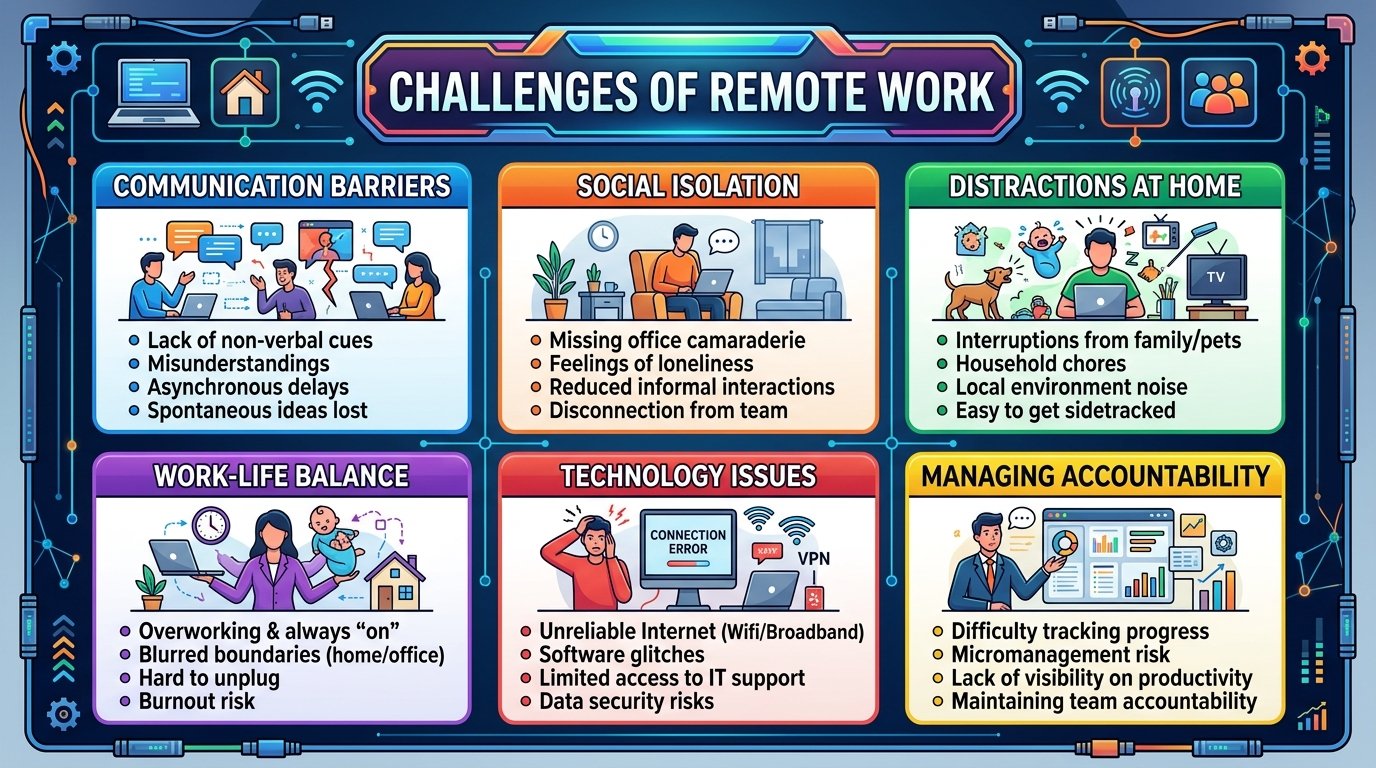
Challenges of Remote Work
Remote work has benefits, but it is not perfect. Without intentional systems, it can create isolation, communication gaps, blurred boundaries, and visibility issues.
Isolation
Without daily office interaction, employees may feel disconnected. Virtual coffee chats, coworking spaces, and team rituals can help rebuild social connection.
Work-Life Blur
When home becomes the office, it can be difficult to switch off. A dedicated workspace, clear start and stop times, and notification boundaries can protect personal time.
Communication Issues
Remote teams need clear writing, documented decisions, and regular check-ins. Good communication is the foundation of remote success.
Security Risks
Remote access can create cybersecurity concerns. Companies should use strong passwords, multi-factor authentication, VPNs, and secure devices.
The Hybrid Work Model
Many organizations now prefer a hybrid model, where employees split time between home and the office. This approach attempts to combine the focus of remote work with the collaboration of in-person meetings.
Common hybrid setups include fixed office days, team anchor days, remote-first policies with optional office use, and role-based flexibility. The best model depends on the company, the work, and the needs of the team.
Productivity: Myth vs Reality
One of the biggest debates around remote work is productivity. Some leaders worry that employees work less when they are not physically visible. But location is not the real issue. Management style is.
Remote work performs best when companies measure outcomes instead of screen time. Clear goals, written expectations, and regular progress updates are more effective than simply watching who sits at a desk the longest.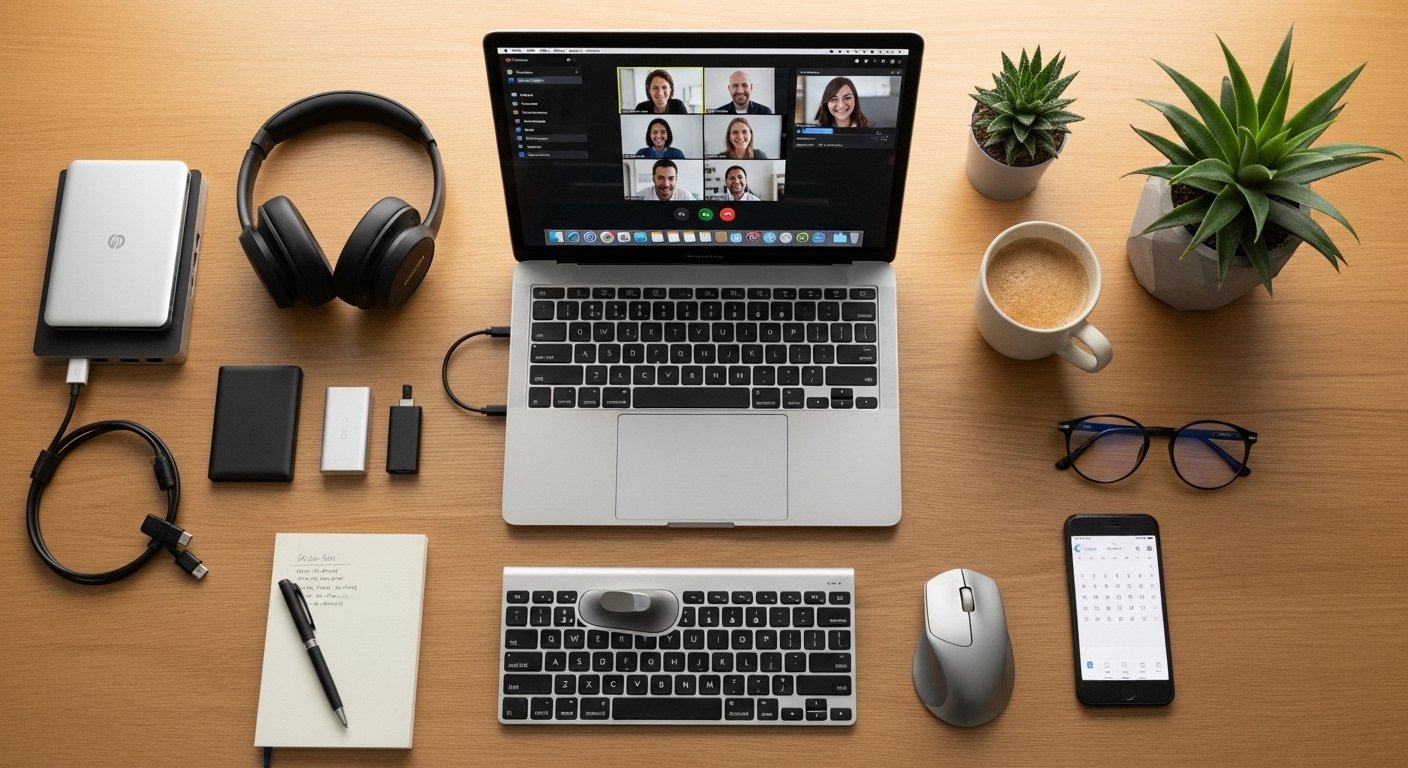
Essential Tools for Remote Work
Successful remote teams rely on digital tools that support communication, planning, documentation, security, and focus.
- Communication: Slack, Microsoft Teams, Discord
- Meetings: Zoom, Google Meet
- Project management: Notion, Asana, Trello, Linear
- Time and focus: Toggl, Clockify, Pomodoro tools
- Security: VPNs, password managers, multi-factor authentication
The Digital Nomad Lifestyle
Remote work has also created a new professional lifestyle: the digital nomad. These workers earn online while living or traveling in different places. For some, it means working from a quiet apartment in another city. For others, it means moving between countries while staying employed.
This lifestyle offers freedom, but it also requires discipline, reliable internet, legal awareness, and strong personal organization.
The Future of Remote Work
The next phase of remote work will be shaped by artificial intelligence, virtual collaboration, stronger labor regulations, and changing city design. AI tools will automate routine tasks and help workers write, summarize, plan, and analyze faster.
Virtual offices and immersive meeting spaces may become more common, especially as hardware improves. Governments are also likely to introduce clearer rules around taxes, benefits, remote expenses, and the right to disconnect.
Remote work will not replace every job, but it will continue to influence how companies hire, how cities grow, and how professionals design their careers.
Tips for Remote Work Success
- Create a dedicated workspace that helps your brain enter work mode.
- Set clear work hours and protect your personal time.
- Communicate clearly and document important decisions.
- Stay socially connected through calls, communities, or coworking.
- Invest in reliable internet, a comfortable chair, and proper equipment.
Common Mistakes to Avoid
Remote workers often struggle when they lack routine, ignore ergonomics, stay isolated, or fail to communicate their achievements. To succeed remotely, you need structure, visibility, health habits, and consistent communication.
Conclusion
Remote work is not just a temporary shift. It is a major transformation in how people work, live, hire, lead, and build careers. Like other major changes in labor history, it is reshaping expectations at every level.
The key to remote success is intentionality. Workers must design strong routines, and companies must build systems that support trust, communication, and measurable outcomes.
The future of work is flexible. The real question is not whether remote work will stay. The real question is how well individuals and organizations will adapt to it.