Nexus BLOGS
Nexus Blogs – Your Hub for Insightful Stories and Smart Content
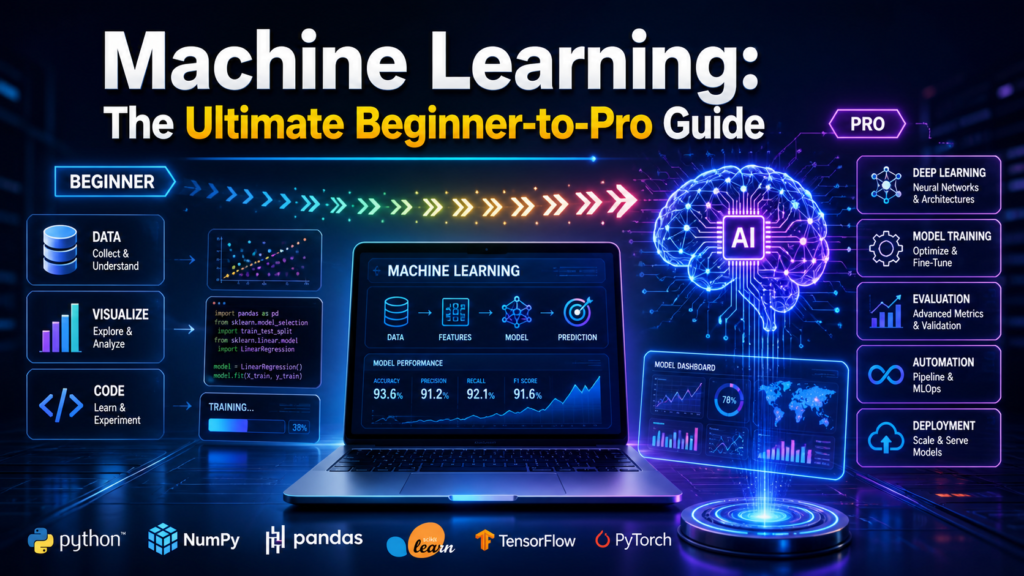
Discover what machine learning is, how it works. Your complete guide to ML in 2025
Table of Contents
1. Introduction: Why Machine Learning Matters Right Now
Imagine software that teaches itself. No manual programming for every scenario — just data, patterns, and predictions. That is the promise of machine learning, and it is no longer science fiction. In 2025, machine learning drives everything from Netflix recommendations to medical diagnoses, fraud detection, and self-driving cars. According to a 2024 report by Grand View Research, the global machine learning market was valued at USD 158.8 billion and is projected to grow at a CAGR of 36.2% through 2030. Whether you are a student, a business owner, or a tech professional, understanding machine learning is no longer optional — it is. In this comprehensive guide, you will learn exactly what machine learning is, how it works, the different essential types, real-world applications, the best tools available, and expert advice to start your journey today.
2. What Is Machine Learning? A Clear Definition
Machine learning is a branch of artificial intelligence (AI) that enables computers to learn from data and
improve their performance over time — without being explicitly programmed for each task. Instead of
following hard-coded rules, a machine learning model identifies patterns in data and uses those patterns to
make predictions or decisions. Arthur Samuel, the pioneer who coined the term in 1959, defined it as: “the field of study that gives
computers the ability to learn without being explicitly programmed.” That definition still holds perfectly true today.
Key Concepts You Must Know
• Algorithm:
A set of rules or instructions the model uses to learn.
• Training Data:
The dataset fed to the model so it can learn patterns.
• Model:
The output of training — a mathematical function that makes predictions.
• Features:
The input variables the model uses (e.g., age, income, pixels).
• Labels:
The output variable the model tries to predict (e.g., spam / not spam).
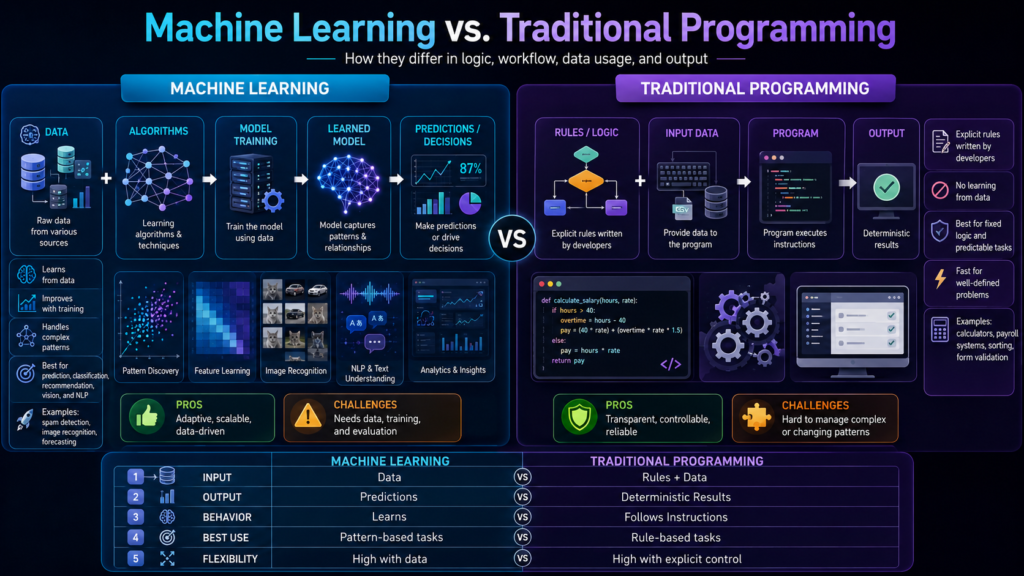
| Traditional Programming | Machine Learning |
|---|---|
| Rules are written by humans | Rules are learned from data |
| Static — doesn’t improve over time | Dynamic — improves with more data |
| Breaks with edge cases | Adapts to new patterns |
| Best for predictable tasks | Best for complex, pattern-heavy tasks |
3. How Machine Learning Works — Step by Step
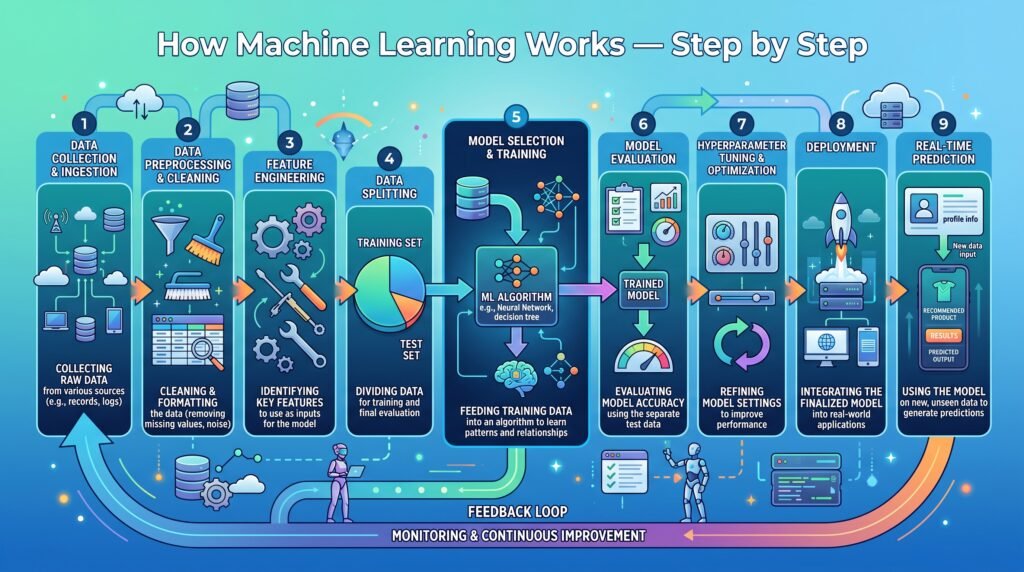
Understanding how machine learning works does not require a math degree. Here is a straightforward breakdown of the process from raw data to working model: